Quando os engenheiros discutem Inconel 601 vs Inconel 718 para tubos de permutadores de calor, the real question is not which alloy is “better” in a general sense. The real question is what is trying to kill the tube first: metal temperature, oxidation, carburization, pressure stress, vibration, or thermal cycling. That distinction matters. In practice, Inconel 601 and Inconel 718 sit in very different corners of nickel alloy design. One is selected primarily for high-temperature environmental resistance. The other is selected primarily for strength.
That is why the comparison of Inconel 601 vs Inconel 718 for heat exchanger tubing should start with failure mode, not with a catalog property sheet.
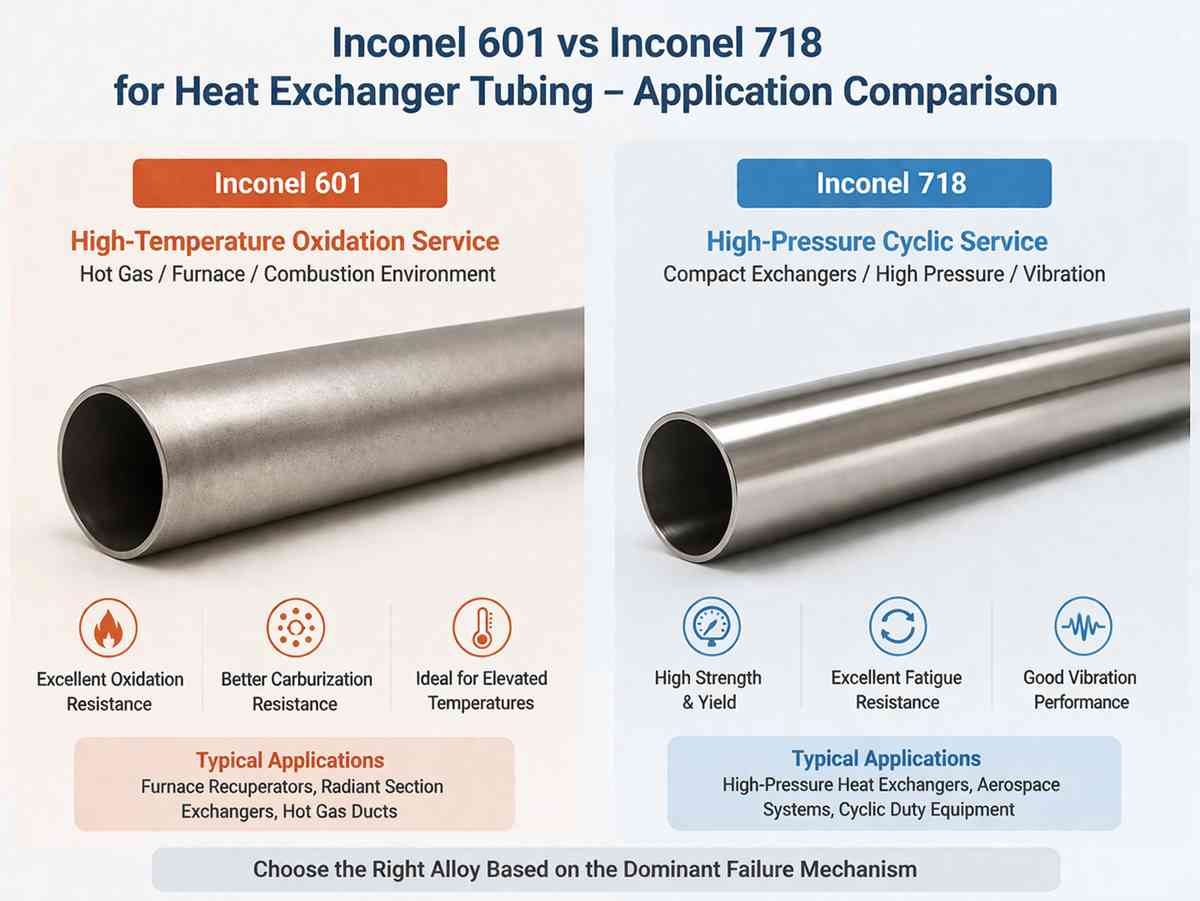
Inconel 601 is a Ni-Cr-Fe alloy strengthened modestly in solid solution, with aluminum added to support a stable protective oxide scale at elevated temperature. In hot oxidizing service, especially where tube skin temperature is high and carbon pickup is a concern, 601 is often the more rational choice. Engineers like it because it resists oxidation well, holds up against carburizing attack better than many common heat-resistant alloys, and remains structurally stable in long-duration thermal exposure.
Inconel 718 is very different. It is a precipitation-hardened Ni-Cr-Fe superalloy strengthened by gamma double-prime and gamma-prime phases, with niobium playing a critical role. It offers dramatically higher tensile and yield strength than 601, which is extremely valuable when the tubing sees high internal pressure, compact geometry, external mechanical loads, vibration, or severe start-stop fatigue below roughly 650°C. In other words, in Inconel 601 vs Inconel 718 for heat exchanger tubing, 718 wins when structural load is the design driver. It does not automatically win when hot-gas exposure is the driver.
A common mistake in exchanger projects is to focus on room-temperature datasheet strength while ignoring long-term environmental degradation. If the tube OD sees oxidizing flue gas, burner-side hot spots, or carbon-rich atmospheres, 718 can be a poor economic answer despite its impressive strength. Above its most comfortable long-term strength regime, the alloy can overage, lose mechanical advantage, and offer less oxidation margin than 601. On the other hand, if the service temperature is moderate but the pressure differential is high, specifying 601 may force thicker walls or shorter design life, which hurts both thermal efficiency and lifecycle cost.
There is also a subtler engineering point. Heat exchanger tubing rarely fails from one isolated variable. Many failures happen because temperature, stress, and chemistry interact. For example, an alloy may have adequate nominal corrosion resistance, but if wall stress is high and shutdown cycles are frequent, crack initiation accelerates. That is why the best answer to Inconel 601 vs Inconel 718 for heat exchanger tubing depends on the full service envelope: process fluid, shell-side atmosphere, metal temperature, pressure, velocity, cleaning chemistry, and shutdown frequency.
What usually makes Inconel 601 the better tubing alloy
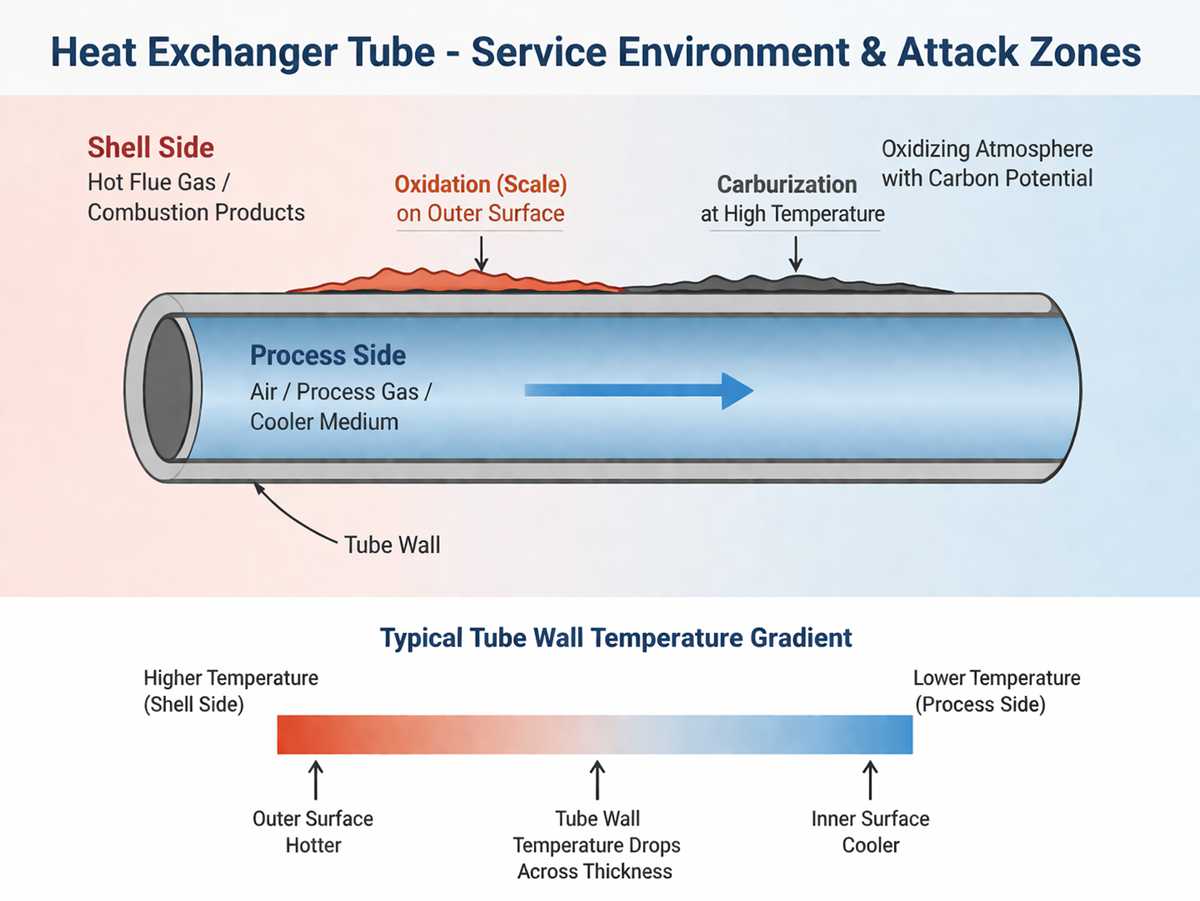
For furnace recuperators, radiant section exchangers, hot gas transfer lines, and other units where tube metal temperature is elevated for long periods, 601 often makes more sense than 718. Its value is not extreme strength; its value is surface stability. The chromium and aluminum combination promotes a tenacious oxide film that slows scaling and helps the tube survive in oxidizing environments where many high-strength alloys lose ground.
This is especially relevant when the tube outer surface sees combustion products while the inner surface carries air, process gas, or another medium at lower temperature. In that situation, the outside skin can become the real design limiter. A designer who selects 718 only because the allowable stress looks attractive may underestimate scale formation, embrittlement risk after prolonged thermal exposure, and the maintenance cost of replacing tubes that have lost wall integrity from environmental attack rather than from burst strength.
What usually makes Inconel 718 the better tubing alloy
In compact heat exchangers, high-pressure tubing bundles, aerospace-derived thermal systems, and cyclic duty equipment, 718 can be the smarter alloy. Its mechanical strength is far superior to 601, so the designer can manage pressure containment more effectively, often with reduced wall thickness or improved resistance to deformation and vibration damage. Fabrication sequence matters, of course: tubing is typically formed in the solution-treated condition and then aged to develop strength. Welding also demands more discipline than with 601 because heat input and post-weld condition influence final properties.
There is an important caveat. If the service medium is wet chloride, sour water, or a strongly reducing chemical environment, neither 601 nor 718 may be the best first-choice tubing alloy. In many exchanger cases, alloys such as 625, 825, or even more specialized grades deserve consideration. Serious engineers know that Inconel 601 vs Inconel 718 for heat exchanger tubing is sometimes a false binary if the process-side corrosion mechanism dominates.
Comparison Table: Inconel 601 vs Inconel 718 for heat exchanger tubing
| Parâmetro | Inconel 601 | Inconel 718 | Engineering Meaning for Tubing Selection |
|---|---|---|---|
| Primary design strength | Solução sólida reforçada | Endurecido por precipitação | 601 is chosen for hot-environment durability; 718 is chosen for high mechanical load |
| Typical service focus | High-temperature oxidation and carburization resistance | High strength, fatigue resistance, pressure containment | Start with failure mode, not alloy popularity |
| Approx. useful temperature regime | Strong in elevated-temperature oxidizing service; often preferred well above 700°C depending on load | Best mechanical advantage generally below about 650°C | 718 is not the automatic answer for hotter skin temperatures |
| Resistência à oxidação | Excelente | Good, but not the main reason to specify it | 601 usually has the edge in hot oxidizing gas exposure |
| Carburization resistance | Better than many common ligas de níquel in hot carbon-rich environments | More limited in this role | Important for furnace-side or carbon-bearing atmospheres |
| Room-temperature strength (typical) | Moderado | Very high in aged condition | 718 clearly wins where pressure stress dominates |
| Creep / long exposure stability | Good for heat-resistant service philosophy | Strong at intermediate temperatures, but aging stability must be respected | Long-duration hot service often favors 601 |
| Formability for tubing | Good in annealed condition | Good before aging; less forgiving after strengthening | Manufacturing route matters more for 718 |
| Welding | Generally straightforward for a heat-resistant alloy | Good weldability, but property control is more sensitive | 718 needs tighter fabrication and heat-treatment discipline |
| Cost logic | Lower strength, but often better value in hot gas duty | Higher alloy and processing cost justified by stress-driven service | Wrong alloy choice can raise both CAPEX and downtime |
| Best-fit application | Hot gas, oxidizing furnace atmosphere, thermal exposure | High-pressure, high-stress, cyclic structural service | Match alloy to the dominant damage mechanism |
Note: Values and service boundaries are application-dependent and vary by product form, heat treatment, code requirements, and actual metal temperature.
The procurement side matters almost as much as the metallurgy. If you are buying exchanger tubing rather than bar or plate, you must confirm product form, heat treatment state, dimensional tolerance, inspection scope, and whether the tubing is seamless or welded-and-redrawn. In Inconel 601 vs Inconel 718 for heat exchanger tubing, that detail can change project performance more than a nominal alloy comparison. A well-made 601 tube with the right wall tolerance and surface quality is often a safer plant decision than a poorly controlled 718 tube selected only for headline strength.
For engineering teams and buyers, the practical selection logic is simple. If the tube is living in a hot oxidizing or carburizing atmosphere, start by challenging whether 601 is the more durable answer. If the tube is living in a high-pressure, high-stress, cyclic mechanical environment below the upper range of 718’s strength advantage, 718 deserves serious consideration. If both hot corrosion and wet-side chemical attack are severe, expand the alloy review immediately rather than forcing the job into a 601-versus-718 debate.
Ending
In a serious design review, Inconel 601 vs Inconel 718 for heat exchanger tubing is really a decision between environmental resistance and structural strength. The correct answer comes from tube wall temperature, atmosphere, pressure, cycle severity, and fabrication route—not from brand familiarity. If you are working on a borderline case, send 28Nickel the design temperature, pressure, medium, and shutdown profile. A short technical review at the selection stage is far cheaper than a tube bundle replacement after startup.
Perguntas e respostas relacionadas
1. Is Inconel 718 stronger than Inconel 601 for heat exchanger tubing?
Yes. In the properly aged condition, Inconel 718 is much stronger than Inconel 601 in both yield and tensile strength. That makes it attractive for high-pressure or high-vibration tubing systems. But higher strength does not automatically mean longer life in hot oxidizing service.
2. Why is Inconel 601 often preferred in hotter exchanger sections?
Because Inconel 601 is designed around oxidation and carburization resistance at elevated temperature. Its chromium-aluminum oxide behavior is a major advantage when the tube skin sees combustion gas, thermal exposure, or carbon-rich atmospheres for long periods.
3. Can Inconel 601 and Inconel 718 both be wrong choices?
Absolutely. If the exchanger duty is dominated by wet chlorides, reducing acids, or mixed aqueous corrosion, neither alloy may be optimal. In those cases, the engineering review should include other nickel alloys rather than forcing a decision between these two grades.