







In aggressive piping systems, the lowest-cost fitting can become the most expensive part of the project. A qualified nickel alloy elbows and tees supplier is not simply selling elbows, tees, reducers, or short-radius bends. The supplier is helping engineers control corrosion risk, weld integrity, pressure-boundary reliability, and documentation gaps before the system goes into service.
For seawater lines, sour gas units, chemical reactors, flue gas desulfurization systems, and high-chloride process loops, elbows and tees are often more vulnerable than straight pipe. Flow changes direction. Turbulence increases. Local temperature gradients appear. Weld seams and heat-affected zones become critical. That is why procurement teams should evaluate a nickel alloy elbows and tees supplier through a materials-engineering lens, not only by unit price.
What Makes a nickel alloy elbows and tees supplier Critical?
Nickel alloy fittings are selected because ordinary stainless steels cannot always survive chloride pitting, crevice corrosion, stress corrosion cracking, or acid attack. Alloys such as Alloy 200/201, Monel 400, Inconel 600/625, Incoloy 800/825, Hastelloy C-276, and Alloy 59 are used because each alloy family has a different balance of nickel, chromium, molybdenum, copper, iron, and controlled carbon.
A reliable nickel alloy elbows and tees supplier should understand that an elbow in a high-velocity chloride slurry is not the same as a tee in a low-flow acid dosing line. The material choice depends on chloride concentration, pH, oxidizing potential, temperature, flow velocity, solids content, cleaning chemistry, and whether the system may see stagnant conditions during shutdown.
ASTM B366 covers factory-made wrought nickel and nickel alloy fittings for pressure piping, including elbows, bends, tees, reducers, caps, lap-joint stub ends, and related fitting types; it also references dimensional standards such as ASME B16.9 and B16.11 for applicable fitting forms. For sour service, NACE MR0175/ISO 15156 provides material selection and qualification guidance for metallic materials used in H₂S-containing oil and gas environments.
How a Professional Supplier Controls Material Risk
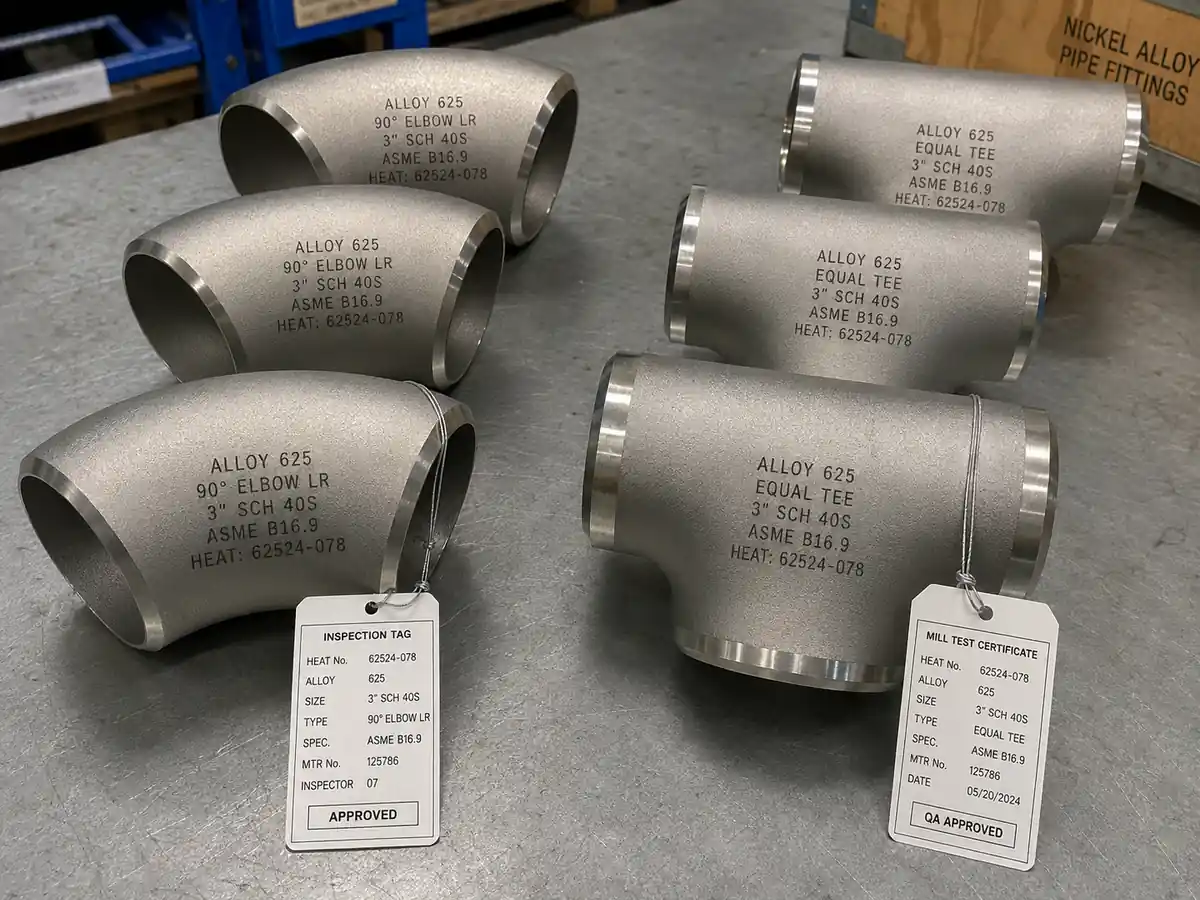
A capable nickel alloy elbows and tees supplier should begin with specification review. This includes UNS grade, ASTM/ASME standard, wall thickness, radius, end preparation, heat treatment condition, supplementary testing, corrosion test requirements, positive material identification, and project documentation.
The most common procurement mistake is assuming that “nickel alloy” is a single material category. It is not. Alloy 625 performs well in many chloride and seawater environments because of its chromium-molybdenum-niobium chemistry. Alloy 825 is often selected for sulfuric and phosphoric acid service. Monel 400 is strong in many seawater and hydrofluoric acid conditions, but it is not a universal solution. Hastelloy C-276 is preferred when mixed acid, wet chlorine, or highly oxidizing chloride environments are present.
A serious nickel alloy elbows and tees supplier will ask for operating data before recommending a grade. Temperature matters. So does chloride level. So does whether the fluid is aerated. Even small amounts of oxidizing contaminants can change the corrosion mechanism. In my experience, many premature failures come from incomplete service-condition data, not from the alloy name written on the purchase order.
Manufacturing Details That Engineers Should Check
For butt-weld elbows and tees, forming quality is essential. Excessive thinning at the extrados of an elbow, poor transition geometry in a tee branch, or uncontrolled cold work can reduce service life. For nickel alloys, hot forming, solution annealing, pickling, passivation, and final dimensional control must be handled carefully. Residual stress is not just a theoretical concern; it can accelerate stress corrosion cracking in the wrong environment.
A professional nickel alloy elbows and tees supplier should provide manufacturing route clarity: seamless or welded construction, forming method, heat treatment temperature range, weld filler compatibility if welded fittings are used, and final inspection criteria. For critical projects, clients may request intergranular corrosion testing, ultrasonic testing, radiographic testing, hardness testing, ferrite checks where applicable, or PMI on each piece.
| Engineering Checkpoint | What to Verify | Why It Matters for Elbows and Tees |
|---|---|---|
| Alloy Grade | UNS number, ASTM grade, heat number | Prevents substitution between similar-looking nickel alloys |
| Dimensional Standard | ASME B16.9, B16.11, MSS SP-43, or project standard | Ensures fit-up, wall thickness, and pressure-boundary consistency |
| Heat Treatment | Solution annealed or stress relieved condition | Controls precipitation, residual stress, and corrosion resistance |
| Wall Thickness | Nominal thickness and thinning after forming | Elbows may thin at the outer radius; tees may thin at the branch |
| End Preparation | Bevel angle, root face, squareness | Affects field welding quality and weld penetration |
| Testing | PMI, hydrotest if required, NDT, hardness, corrosion test | Confirms material identity and service suitability |
| Documentation | MTC EN 10204 3.1/3.2, inspection report, packing list | Supports EPC approval, customs clearance, and traceability |
| Surface Condition | Pickled, passivated, free from iron contamination | Reduces initiation sites for pitting or crevice corrosion |
Procurement Guidance from a nickel alloy elbows and tees supplier
For engineers and buyers, the best question is not “What is your price?” but “How do you prevent hidden risk?” A qualified nickel alloy elbows and tees supplier should be able to explain lead time, raw material origin, forming capability, welding procedure qualification, inspection plan, and documentation package without hesitation.
For example, if the project requires Alloy 625 elbows for seawater injection, the supplier should confirm N06625 material, fitting standard, schedule, radius, heat treatment, PMI scope, and MTC traceability. If the project requires Hastelloy C-276 tees for wet chlorine service, the supplier should discuss C276 chemistry, solution annealing, surface cleanliness, packaging protection, and contamination control. These are not small details. They directly affect service life.
28Nickel supports projects where corrosion allowance alone is not enough. We focus on nickel alloy elbows, tees, reducers, caps, flanges, and pipe materials for chemical processing, offshore engineering, desalination, marine systems, heat exchangers, pulp and paper, and oil and gas applications. As a nickel alloy elbows and tees supplier, our role is to help procurement teams reduce uncertainty before material release.
Conclusion: Choose Technical Certainty, Not Just Stock
Nickel alloy fittings are usually purchased for difficult service, not ordinary piping. Therefore, a nickel alloy elbows and tees supplier must be evaluated by alloy knowledge, manufacturing control, inspection capability, and traceability discipline.
The cheapest fitting is rarely cheap if it causes shutdown, leakage, weld repair, or corrosion investigation. A dependable nickel alloy elbows and tees supplier helps engineers choose the correct alloy, confirm the right standard, avoid mixed-material risk, and prepare documentation that can survive EPC, end-user, and third-party inspection.
For critical systems, send the operating conditions, drawing, material specification, and inspection requirements before placing the order. The earlier the supplier reviews the technical data, the easier it is to prevent costly mismatch.
Related Q&A
1. What information should I send to a nickel alloy elbows and tees supplier before quotation?
You should provide alloy grade or UNS number, fitting type, size, schedule or wall thickness, standard, quantity, end connection, service fluid, design temperature, design pressure, corrosion test requirements, NDT requirements, and documentation level. A good nickel alloy elbows and tees supplier will use this information to check whether the requested alloy and fitting design match the actual service environment.
2. Are seamless nickel alloy elbows always better than welded elbows?
Not always. Seamless fittings are often preferred for severe service, but welded fittings can be acceptable when the weld procedure, filler metal, heat treatment, NDT, and corrosion performance are properly controlled. The right choice depends on pressure class, diameter, alloy grade, service medium, code requirement, and inspection plan.
3. Why do nickel alloy tees fail at the branch area?
The branch area of a tee experiences geometry-related stress concentration, flow disturbance, weld influence, and possible local wall thinning. In corrosive media, these factors can accelerate pitting, crevice corrosion, erosion-corrosion, or stress corrosion cracking. That is why dimensional inspection, wall-thickness verification, proper heat treatment, and correct alloy selection are essential.