








Incoloy 825 pipe fittings for acid service are selected when a piping system needs better resistance to sulfuric acid, phosphoric acid, pickling solutions, mixed acid streams, chloride stress corrosion cracking, and localized attack than common stainless steels can normally provide. For procurement teams, the important question is not only whether Alloy 825 can resist the media, but also whether the fittings can be supplied to the right ASTM/ASME specification, size, wall schedule, end preparation, certificate scope, and delivery date.
28Nickel supplies Incoloy 825 elbows, tees, reducers, caps, stub ends, flanges, and related nickel alloy piping components for chemical processing, acid production, pollution control, pickling, offshore, and other corrosive service lines. If your drawing names UNS N08825, ASTM B366, ASME SB366, or an equivalent project specification, send the fitting type, NPS, schedule, quantity, drawing notes, certificate requirement, and destination so we can check stock, production route, and shipping options before quoting.
Contact us for a free quote if your project requires Incoloy 825 pipe fittings for acid service, urgent replacement, or document-controlled industrial piping packages.
What Is Incoloy 825 and Why Does It Work in Acid Service?
Incoloy 825, also called Alloy 825 or UNS N08825, is a nickel-iron-chromium alloy strengthened by a carefully balanced addition of molybdenum, copper, and titanium. The alloy was developed for corrosion resistance rather than high-temperature strength alone. That makes it useful in wet process piping where the service fluid may contain acids, chlorides, oxidizing salts, or changing plant conditions.
The nickel content supports resistance to chloride-ion stress corrosion cracking. Chromium improves performance in oxidizing environments such as nitric acid, nitrates, and oxidizing salts. Molybdenum helps resist pitting and crevice corrosion, especially where chlorides are present. Copper and molybdenum together improve resistance in reducing acid environments such as sulfuric and phosphoric acid. Titanium helps stabilize the material against sensitization when proper heat treatment is used.
For acid piping, this mix is practical. A plant may not be handling one pure laboratory acid. The actual stream can include traces of chlorides, iron salts, oxidizing contamination, wash water, or temperature cycling. Alloy 825 gives engineers a wider corrosion-resistance window than 304L, 316L, or some duplex stainless grades in many acid handling systems.
Common Service Areas
- Sulfuric acid handling and acid production piping
- Phosphoric acid service, fertilizer equipment, and process transfer lines
- Pickling lines, spent acid handling, and mixed acid drainage
- Pollution-control scrubbers, ducting, and quench sections
- Oil and gas sour or chloride-containing process streams where project rules permit Alloy 825
- Nuclear fuel reprocessing and radioactive waste handling equipment where the specification calls for UNS N08825
Material selection should still be confirmed against the actual medium, concentration, temperature, velocity, aeration, contaminants, and cleaning procedure. Alloy 825 is strong in many acid systems, but no nickel alloy is universal. If the service includes strong hydrochloric acid, hydrofluoric acid, wet chlorine, or highly oxidizing chloride mixtures, the project may need a higher alloy such as C-276, C-22, or another grade after corrosion review.
Which Standards Should Engineers Name for Alloy 825 Pipe Fittings?
For factory-made wrought nickel alloy pipe fittings, procurement documents often reference ASTM B366 or ASME SB366. Dimensional standards are usually separate from material standards. A butt-weld elbow may need ASTM B366/ASME SB366 for material and manufacturing requirements, but ASME B16.9 for dimensions. A socket-weld fitting may be ordered to ASME B16.11. Stub ends and light-wall components may involve MSS or project-specific details.
| Requirement | Common Reference | What to Confirm in the RFQ |
|---|---|---|
| Material grade | UNS N08825 / Alloy 825 / Incoloy 825 | Confirm exact grade name, UNS number, and whether dual marking is needed. |
| Wrought nickel alloy fittings | ASTM B366 / ASME SB366 | Confirm fitting class, product type, heat treatment, and test certificate scope. |
| Butt-weld dimensions | ASME B16.9 or project drawing | Confirm NPS, schedule, long-radius or short-radius, end bevel, and tolerance. |
| Socket/threaded fittings | ASME B16.11 | Confirm pressure class, socket bore, thread type, and marking requirements. |
| Flanges | ASME B16.5, ASME B16.47, or project drawing | Confirm class, facing, bore, standard, and gasket surface finish. |
| Inspection | EN 10204 3.1, PMI, dimensional report, optional NDE | Confirm third-party inspection, UT/PT/RT, or customer hold points before production. |
One common mistake is to request only “Incoloy 825 fittings” without the end standard and dimensions. That is not enough for a reliable quote. A 4 inch Schedule 40S long-radius butt-weld elbow, a 4 inch Class 300 socket-weld elbow, and a custom machined reducing tee may all be called Alloy 825 fittings, but their stock route, inspection method, weight, lead time, and price can be completely different.
What Chemical Composition Should Incoloy 825 Fittings Meet?
Alloy 825 fittings should be produced from material whose heat analysis meets the applicable specification and project limits. The chemistry below is a practical reference range for UNS N08825. Always use the purchase order, applicable standard, and mill certificate as the controlling documents.
| Element | Typical Limiting Range, % | Why It Matters in Acid Piping |
|---|---|---|
| Nickel | 38.0 to 46.0 | Supports resistance to chloride-ion stress corrosion cracking. |
| Chromium | 19.5 to 23.5 | Improves resistance to oxidizing media and passive film stability. |
| Iron | Balance, 22.0 min commonly referenced | Forms the nickel-iron-chromium base of the alloy. |
| Molybdenum | 2.5 to 3.5 | Helps resist pitting, crevice corrosion, and reducing acid attack. |
| Copper | 1.5 to 3.0 | Improves resistance in reducing acids such as sulfuric and phosphoric acid. |
| Titanium | 0.6 to 1.2 | Stabilizes the alloy against intergranular corrosion after proper heat treatment. |
| Carbon, sulfur, silicon, manganese | Limited by specification | Controlled to support corrosion resistance, weldability, and clean production. |
When reviewing an MTC, do not look only for nickel. Many material problems start with incomplete chemistry verification. For acid service, molybdenum, copper, chromium, carbon, and titanium are all meaningful. If the fittings are welded or formed from pipe or plate, check whether the certificate links the finished item back to the correct heat number and starting material.
Available Types of Incoloy 825 Pipe Fittings
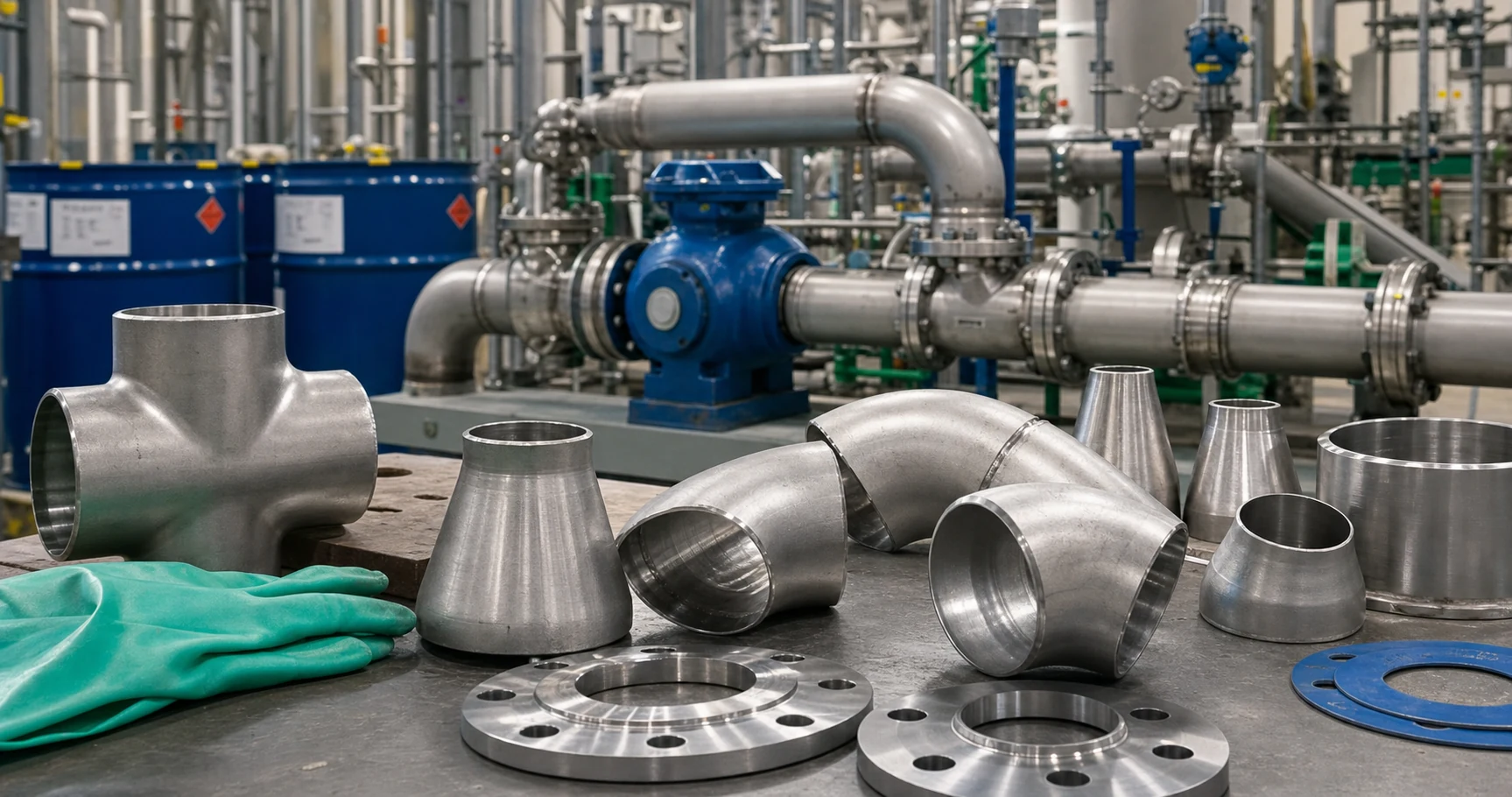
Industrial projects usually need a package of fittings rather than one loose item. The most common request is a combination of elbows, tees, reducers, caps, flanges, and stub ends matched to the same pipe schedule and documentation scope. 28Nickel can review both standard fittings and drawing-based parts.
Butt-Weld Fittings
Butt-weld fittings are common in acid transfer lines because welded joints reduce crevice areas compared with some threaded connections and are suitable for permanent process piping. Typical forms include 45 degree elbows, 90 degree elbows, 180 degree returns, equal tees, reducing tees, concentric reducers, eccentric reducers, caps, and stub ends. The request should state NPS, schedule, radius, wall thickness, end preparation, and whether the project requires seamless or welded construction.
Socket-Weld and Threaded Fittings
Socket-weld and threaded Alloy 825 fittings may be used in smaller bore utility or instrument-related corrosive service, depending on plant standards. These fittings are usually ordered by pressure class and connection type. Because crevice corrosion and stagnant fluid can be concerns in acid systems, engineers should confirm whether socket or threaded joints are acceptable for the actual medium.
Flanges, Stub Ends, and Special Components
Flanges may be required in the same alloy where disassembly, inspection, or equipment connection is expected. Common styles include weld neck, slip-on, socket-weld, blind, threaded, lap joint, and reducing flanges. For lined equipment, lap joint flanges and stub ends can be relevant. For non-standard piping, custom machined nozzles, branch pieces, transition fittings, and loose rings may be reviewed from drawings.
| Fitting Type | Typical Purchase Detail | Application Note |
|---|---|---|
| 90 degree LR elbow | NPS, schedule, ASTM B366, ASME B16.9 | General acid process piping direction change. |
| Reducing tee | Run size, branch size, schedule, weld-end details | Branch connection for transfer or sampling line. |
| Concentric reducer | Large end, small end, schedule, length standard | Vertical or pump discharge transition where centerline alignment is preferred. |
| Eccentric reducer | Flat side orientation, end size, schedule | Pump suction lines where pocket avoidance is important. |
| Cap | NPS, schedule, end prep | Line termination, test spool, or future connection. |
| Stub end | Short or long pattern, lap joint flange match | Demountable corrosion-resistant piping connection. |
How to Select Incoloy 825 for Sulfuric, Phosphoric, and Mixed Acid Lines
Acid service is not a single condition. A fitting that works in one plant may not be suitable in another if the concentration, temperature, oxidizing contamination, chlorides, or flow conditions change. The selection should begin with the corrosion mechanism and then move to the fitting standard.
Sulfuric Acid Service
Alloy 825 is often considered for sulfuric acid because the combined nickel, molybdenum, and copper additions improve resistance in reducing acid environments. It can be useful in acid production, acid storage transfer, spent acid handling, and chemical process lines. The details matter: concentration, aeration, temperature, velocity, and contamination can shift corrosion behavior. For high-temperature or unusual concentrations, corrosion data and field experience should be checked before final selection.
Phosphoric Acid Service
Phosphoric acid systems may include chlorides, fluorides, solids, or other contaminants depending on the process route. Alloy 825 can be a strong candidate where 316L or 904L lacks the required margin, but equipment designers should still review erosion, deposits, weld crevices, and cleaning chemistry. For fittings near pumps, valves, and elbows, flow disturbance and solids can make local conditions more aggressive than a simple chemical compatibility table suggests.
Pickling and Mixed Acid Service
Pickling lines and mixed acid waste streams are difficult because the chemistry can vary during operation. Alloy 825 may be used in tanks, heating coils, headers, and transfer piping when the medium fits its corrosion-resistance profile. Where hydrochloric acid, hydrofluoric acid, or oxidizing chloride mixtures are significant, a higher alloy or lining system may be needed. Share the complete media data with the material engineer before ordering fittings.
What Size Range and Wall Schedule Can Be Supplied?
Typical RFQs include NPS 1/2 to NPS 24 for standard butt-weld fittings, with larger sizes or fabricated fittings reviewed from drawings. Wall schedules may include Schedule 10S, 40S, 80S, 160, and special wall thicknesses depending on the product form and production route. Small bore forged fittings are usually ordered by class, such as Class 3000, 6000, or 9000, depending on the applicable standard and plant piping specification.
Stock availability changes with market demand and mill schedules. Common sizes may be available faster, while non-standard wall thickness, strict inspection, special heat treatment, or large-quantity packages may require production. If the project is for shutdown maintenance, please state the required arrival date at the RFQ stage. It is better to know early whether a substitute size, spool redesign, or partial shipment is needed.
| RFQ Item | What to Send | Why It Matters |
|---|---|---|
| Nominal size | NPS or DN for every fitting | Controls dimensions, weight, and matching pipe. |
| Wall schedule | 10S, 40S, 80S, 160, XXS, or actual wall | Controls pressure design and weld preparation. |
| End type | Butt-weld, socket-weld, threaded, flanged | Determines manufacturing route and inspection. |
| Standard | ASTM/ASME material standard plus dimensional standard | Prevents mismatched compliance claims. |
| Quantity | Pieces per size and fitting type | Affects stock allocation, production batch, and price. |
| Documents | MTC, PMI, NDE, third-party inspection, marking | Must be planned before shipment, not after delivery. |
Manufacturing Route and Heat Treatment Notes
Alloy 825 fittings can be made by forming, forging, machining, and welding routes depending on the fitting type and size. Butt-weld elbows and reducers may be formed from pipe or plate-derived hollows. Forged fittings and flanges are produced from suitable forged stock and then machined. Custom fittings may combine forming and machining with customer-approved drawings.
Because corrosion resistance is the main reason for selecting Alloy 825, heat treatment and surface condition deserve attention. The finished material should be supplied in the condition required by the standard and project specification. Surface contamination from carbon steel tools, grinding media, or handling can create future corrosion problems, so cleaning, protection, and packing are not cosmetic details. They are part of corrosion-control discipline.
For welded fittings, ask whether the project requires weld maps, filler metal records, procedure qualifications, production weld NDE, or corrosion-related post-weld cleaning. If the fittings will be assembled into pressure piping under ASME B31.3 or another code, the pipe fabricator and owner should align the fitting purchase specification with the final welding procedure.
Inspection, Certificates, and Traceability
A good Alloy 825 fitting package should be traceable from the finished fitting back to the heat number. The minimum document package usually includes material test certificates and dimensional confirmation. For high-value chemical projects, additional controls may be requested.
- EN 10204 3.1 material certificate or equivalent mill certificate
- Chemical composition and mechanical property report
- Heat number marking or tagging for each fitting or bundle
- Positive material identification (PMI) report when required
- Dimensional inspection report for critical fittings
- Visual inspection and surface condition confirmation
- Optional PT, RT, UT, or third-party inspection depending on drawing and project rules
- Packing list, commercial invoice, and export documents for international shipment
Do not assume every test is automatically included. Some inspections require production planning, special equipment, or third-party scheduling. If your project has an ITP, inspection hold point, or owner-approved vendor list, provide it with the inquiry. This helps avoid price revisions and delivery delays after order placement.
How Incoloy 825 Compares With Stainless Steel and Other Nickel Alloys
Alloy 825 is often chosen when stainless steel is close to its limit but a project does not necessarily require the cost and corrosion range of the most highly alloyed nickel materials. The comparison below is a practical purchasing guide, not a substitute for corrosion testing.
| Material | Where It May Fit | When Alloy 825 May Be Preferred |
|---|---|---|
| 316L stainless steel | Mild chemical service, lower chloride exposure, moderate cost | When chlorides, acids, or stress corrosion cracking risk exceed 316L capability. |
| 904L stainless steel | Sulfuric acid and chloride service at moderate severity | When nickel alloy chemistry and project experience favor UNS N08825. |
| Duplex stainless steel | Strength and chloride resistance in many neutral chloride services | When reducing acids, mixed acid chemistry, or project specification points to Alloy 825. |
| Alloy 625 | High chloride and seawater-related service, higher strength options | When sulfuric/phosphoric acid resistance and cost balance favor Alloy 825. |
| Hastelloy C-276 / C-22 | More severe mixed acids, chlorides, oxidizers, and wet chlorine-related service | When service conditions are within Alloy 825’s practical range and cost matters. |
Price Factors for Incoloy 825 Pipe Fittings
Incoloy 825 fittings are priced by more than alloy name. Raw material cost is important, but the final quote also reflects fitting type, size, wall thickness, manufacturing route, testing, quantity, and delivery term. A small quantity of rare thick-wall fittings can have a higher unit price than a larger standard package because setup, machining, and certificate work are spread over fewer pieces.
- Nickel and molybdenum market movement: Alloy cost changes with the metals market and available mill stock.
- Size and wall thickness: Larger NPS and heavier wall schedules increase material weight and forming difficulty.
- Fitting complexity: Reducing tees, lateral fittings, and custom drawing parts take more planning than standard elbows.
- Inspection scope: PMI, NDE, third-party inspection, and special marking add cost and lead time.
- Quantity: Batch production and stock allocation usually improve pricing for repeated sizes.
- Freight and packing: Heavy nickel alloy fittings may require export wooden cases, protective wrapping, or palletized packing.
Packing and Shipment for Acid-Service Fittings
Nickel alloy fittings should be packed to protect both dimensions and surface condition. Ends are commonly protected with caps, wrapping, or plywood/wooden cases depending on size and route. Heavy fittings should be separated to prevent impact damage. If fittings are going to a coastal site, offshore yard, or long-distance sea shipment, packing moisture control should be considered.
For urgent shutdown work, air freight may be possible for small and medium fittings. Large flanges, thick-wall tees, or bulk packages may be more economical by sea or land freight. Include destination port, final city, Incoterms preference, and required arrival date when requesting a quote.
RFQ Checklist for Incoloy 825 Pipe Fittings
To receive a fast and accurate quote, send the following information in one email or inquiry form.
- Material: Incoloy 825 / Alloy 825 / UNS N08825
- Fitting type: elbow, tee, reducer, cap, stub end, flange, forged fitting, or drawing part
- Standard: ASTM B366 / ASME SB366 plus dimensional standard such as ASME B16.9 or ASME B16.11
- Size: NPS or DN, schedule or wall thickness, radius, end type, class, and bore if relevant
- Quantity: pieces per line item
- Service: acid type, concentration, temperature, pressure, chlorides, and unusual contaminants if available
- Documents: MTC 3.1, PMI, inspection report, NDE, third-party inspection, or owner requirements
- Delivery: destination, Incoterms, required date, and whether partial shipment is acceptable
- Marking and packing: heat number, item number, project tag, end protection, export case requirement
Frequently Asked Questions
Is Incoloy 825 suitable for sulfuric acid piping?
Incoloy 825 is widely considered for sulfuric acid service because nickel, molybdenum, and copper improve resistance in reducing acid conditions. Suitability depends on concentration, temperature, velocity, aeration, impurities, and plant experience. For critical systems, ask the project engineer to review corrosion data and operating conditions before purchase.
Can Alloy 825 fittings be supplied to ASTM B366?
Yes, ASTM B366/ASME SB366 is commonly referenced for factory-made wrought nickel alloy fittings, including Alloy 825 where the specification and project requirements match. The purchase order should also name the dimensional standard, such as ASME B16.9 for butt-weld fittings or ASME B16.11 for socket-weld and threaded fittings.
What is the difference between seamless and welded Alloy 825 fittings?
Seamless fittings are produced without a longitudinal weld in the starting hollow, while welded fittings use welded pipe or plate-derived construction. The right choice depends on size, availability, pressure design, project specification, and inspection requirements. For many large sizes, welded construction may be the practical production route.
Do Incoloy 825 fittings need PMI testing?
PMI is not always mandatory, but it is commonly requested for nickel alloy projects to confirm alloy identity before shipment or installation. PMI is especially useful when multiple nickel alloys or stainless steels are handled in the same project warehouse.
Can 28Nickel supply mixed packages with pipe, fittings, and flanges?
Yes. Mixed packages can be reviewed when the RFQ includes grade, standard, size, quantity, and document requirements for each item. Combining pipe, fittings, and flanges can simplify export packing and project traceability, but the schedule should be planned early.
How fast can Incoloy 825 fittings be delivered?
Lead time depends on stock, size, quantity, and inspection scope. Standard small and medium fittings may be faster when available from stock. Custom sizes, thick-wall fittings, special NDE, or third-party inspection usually require additional production time.
What information is needed for a reliable price?
At minimum, send material grade, fitting type, size, wall schedule or class, standard, quantity, certificate requirement, and destination. If the line is for acid service, include acid type, concentration, temperature, and chloride level when available. This helps avoid quoting a fitting that meets the size but not the service requirement.
Verifiable Sources
Request a Quote
For Incoloy 825 pipe fittings in acid service, send your line list, drawings, material standard, size schedule, quantity, inspection scope, and delivery destination. 28Nickel can review stock, production, documentation, packing, and shipping so your purchasing team receives a practical quote rather than a generic alloy price.