











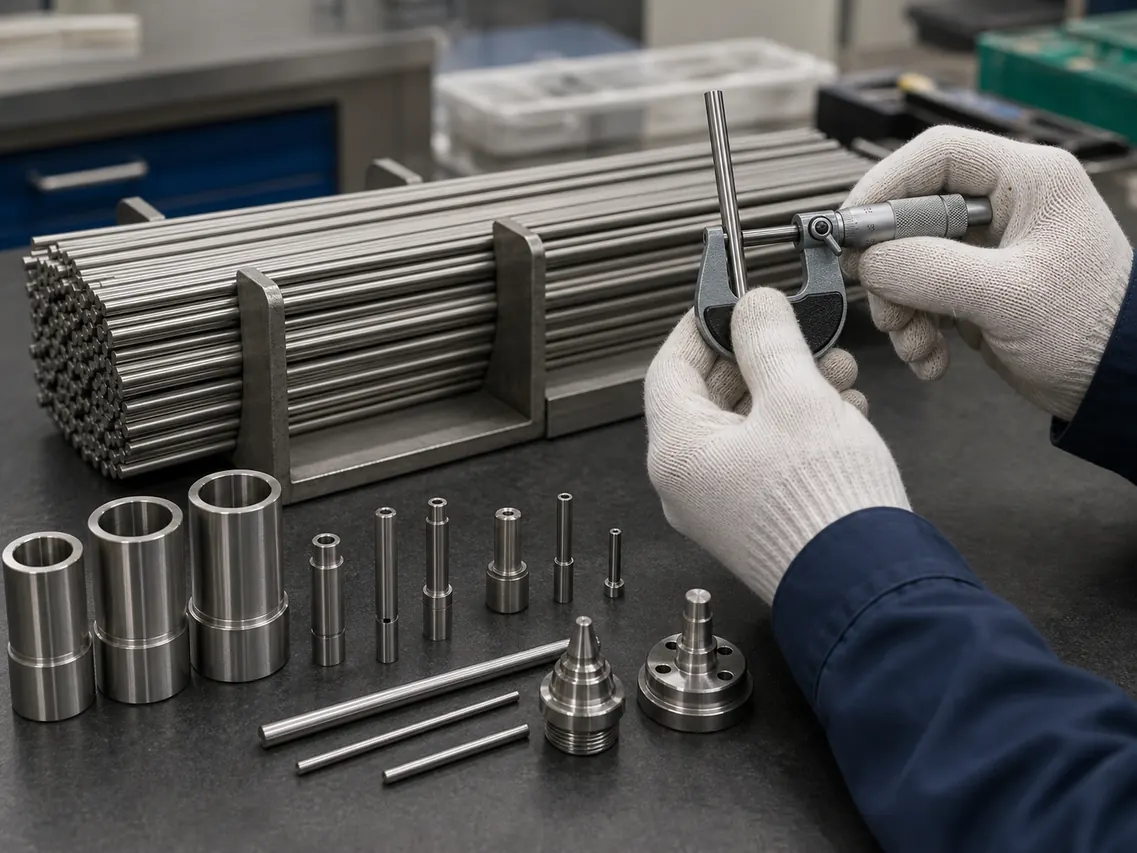
Specifying Hastelloy C22 bar for wet chlorine valve stems should reduce project risk, not merely replace one alloy name with another. A technically sound order starts with service chemistry and load, continues through ASTM B574 and UNS N06022, and ends with dimensions, condition, traceability, inspection, fabrication controls, and packing that match the job.
The service in this case combines wet chlorine, hypochlorous chemistry, chlorides, oxidizing conditions, packing crevices, intermittent exposure, cyclic motion, and shutdown condensation. C22 bar is compelling for valve stems where oxidizing chloride chemistry reaches crevices and moving surfaces and where a broad corrosion window is more important than maximum bulk strength. That statement is a selection rationale, not a guarantee of immunity. Wet chlorine severity depends on water content, temperature, chlorine concentration, pH, chlorides, contaminants, and whether surfaces dry between cycles. Packing geometry and stagnant areas can be more aggressive than the main flow.
For purchasing Hastelloy C22 bar for wet chlorine valve stems, bar bought exactly at finished size can leave no allowance for scale removal, straightening, work holding, test coupons, or final machining cleanup. The inquiry therefore needs diameter or section size, ordered length, straightness, surface condition, dimensional tolerance, and machining allowance; it also needs the ordered condition, certificate scope, test requirements, delivery schedule, and destination. When one item is left open, suppliers can quote materially different products under descriptions that look similar.
This guide is written for engineers, fabricators, maintenance teams, and industrial buyers. It explains where Hastelloy C22 earns its place, where its selection boundary lies, how to specify bar to ASTM B574, and how to review a quotation without confusing a mill certificate with proof of service suitability.
Contact 28Nickel for a project quotation with the grade, form, dimensions, quantity, service conditions, inspection scope, destination, and required delivery date.
Material Identity, UNS Designation and ASTM Control
Hastelloy C22 is identified as UNS N06022 and is a nickel-chromium-molybdenum-tungsten alloy designed for broad oxidizing and reducing chemical resistance. For this article, the procurement standard is ASTM B574 and the ordered form is bar. The purchase order should repeat all three identity points because commercial grade names, UNS designations, and ASTM form standards serve different purposes.
ASTM compliance controls product requirements within the scope of the standard. It does not, by itself, approve Hastelloy C22 for wet chlorine valve stems, calculate corrosion allowance, qualify a weld procedure, or prove remaining life. Those responsibilities stay with the project specification and design authority. The delivered condition should be stated as the ordered annealed or age-hardened condition, with heat-treatment route and mechanical acceptance tied to the drawing.
Nominal Chemistry Review
| Element | Nominal specification range | Engineering relevance |
|---|---|---|
| Nickel | Balance | Provides the base for broad corrosion resistance |
| Chromium | 20.0-22.5% | Gives strong resistance in oxidizing chemical conditions |
| Molybdenum | 12.5-14.5% | Improves resistance to reducing acids and localized attack |
| Tungsten | 2.5-3.5% | Adds margin against pitting and crevice corrosion |
| Iron | 2.0-6.0% | Controlled part of the alloy balance |
These ranges are a procurement-oriented summary for Hastelloy C22, not a substitute for the current edition of ASTM B574. Acceptance must use the values required by the purchase order and the actual mill certificate. The buyer should check that heat number, grade, UNS, chemistry, dimensions, condition, and test results all refer to the same delivered bar.
Chemistry explains why Hastelloy C22 behaves as it does, but microstructure and condition determine how that chemistry arrives in wet chlorine valve stems. Heat treatment, cold work, grain structure, surface, and section size can influence response and fabrication. For this bar, do not accept an offer that leaves condition undecided after order placement.
Connect Alloy Metallurgy to the Service Problem
The selection case for Hastelloy C22 bar for wet chlorine valve stems rests on several different contributions rather than one headline property. C22 bar is compelling for valve stems where oxidizing chloride chemistry reaches crevices and moving surfaces and where a broad corrosion window is more important than maximum bulk strength. The following points explain how the alloy’s metallurgy connects to the stated service.
A wide corrosion window in mixed chemical environments
Hastelloy C22 offers a wide corrosion window in mixed chemical environments. In wet chlorine valve stems, this supports the design by addressing part of the combined exposure: wet chlorine, hypochlorous chemistry, chlorides, oxidizing conditions, packing crevices, intermittent exposure, cyclic motion, and shutdown condensation. A quotation should not claim this benefit without confirming grade identity and ordered condition. The project should identify the exact location where this property is needed and the condition that would invalidate the assumption.
Strong resistance to pitting and crevice corrosion in chloride-bearing service
Hastelloy C22 offers strong resistance to pitting and crevice corrosion in chloride-bearing service. In wet chlorine valve stems, this supports the design by addressing part of the combined exposure: wet chlorine, hypochlorous chemistry, chlorides, oxidizing conditions, packing crevices, intermittent exposure, cyclic motion, and shutdown condensation. Its practical value appears at the most severe local zone, not in a generic property table. The project should identify the exact location where this property is needed and the condition that would invalidate the assumption.
Good weld-area corrosion performance when correct procedures are used
Hastelloy C22 offers good weld-area corrosion performance when correct procedures are used. In wet chlorine valve stems, this supports the design by addressing part of the combined exposure: wet chlorine, hypochlorous chemistry, chlorides, oxidizing conditions, packing crevices, intermittent exposure, cyclic motion, and shutdown condensation. This benefit matters only when the process and fabrication assumptions remain valid. The project should identify the exact location where this property is needed and the condition that would invalidate the assumption.
Useful margin where process chemistry shifts between operating stages
Hastelloy C22 offers useful margin where process chemistry shifts between operating stages. In wet chlorine valve stems, this supports the design by addressing part of the combined exposure: wet chlorine, hypochlorous chemistry, chlorides, oxidizing conditions, packing crevices, intermittent exposure, cyclic motion, and shutdown condensation. The drawing should translate this benefit into geometry, condition, and inspection requirements. The project should identify the exact location where this property is needed and the condition that would invalidate the assumption.
The selection boundary is equally important: No C-family alloy is universally immune. Concentration, temperature, contaminants, deposits, aeration, and cleaning chemistry must be reviewed as a complete cycle. Wet chlorine severity depends on water content, temperature, chlorine concentration, pH, chlorides, contaminants, and whether surfaces dry between cycles. Packing geometry and stagnant areas can be more aggressive than the main flow. This is why responsible technical writing distinguishes a defensible candidate from a universal recommendation.
Room-temperature tensile values and handbook corrosion summaries are useful for screening Hastelloy C22, but acceptance should use ASTM B574, project design values, and the heat-specific certificate. For wet chlorine valve stems, corrosion behavior must be evaluated at representative concentration, temperature, contaminants, aeration, velocity, deposits, and stress.
Build the Material Case Around the Whole Process Cycle
Material selection for Hastelloy C22 bar for wet chlorine valve stems should use a timeline rather than one normal operating point. Startup, stable operation, process upset, cleaning, and shutdown can each create a different corrosion potential, temperature, mechanical load, or wetting condition. A process record that captures only nominal chemistry can miss the short stage that determines service life.
| Process stage | Material concern | Question for the design review |
|---|---|---|
| Closed standby | Condensate and chlorine remain at packing and seal areas. | Define standby duration and venting. |
| Opening | Deposits and corrosion products can score the stem surface. | Inspect wiping and packing contact zones. |
| Flow control | Partial opening can create velocity, vibration, and wet-dry boundaries. | Review throttling duty and local temperature. |
| Isolation | Trapped wet chlorine may remain between closed boundaries. | Provide drainage or controlled purge. |
| Maintenance | Surface polishing can change diameter and packing performance. | Set minimum diameter and finish acceptance. |
The table is also a practical RFQ tool. The supplier does not need confidential process know-how, but the material review does need enough information to distinguish normal exposure from the worst credible combination. For wet chlorine valve stems, that means documenting the range behind each phrase in the service summary: wet chlorine, hypochlorous chemistry, chlorides, oxidizing conditions, packing crevices, intermittent exposure, cyclic motion, and shutdown condensation.
For wet chlorine valve stems, separate bulk fluid temperature from actual Hastelloy C22 metal temperature. Heat transfer, insulation, deposits, poor flow, direct heat, and ambient cooling can move the metal above or below the fluid value. Also separate average chemistry from local chemistry around the ordered bar; low-flow zones, vapor boundaries, deposits, and drying surfaces can concentrate dilute species.
The most credible Hastelloy C22 recommendation includes a stopping rule. No C-family alloy is universally immune. Concentration, temperature, contaminants, deposits, aeration, and cleaning chemistry must be reviewed as a complete cycle. Wet chlorine severity depends on water content, temperature, chlorine concentration, pH, chlorides, contaminants, and whether surfaces dry between cycles. Packing geometry and stagnant areas can be more aggressive than the main flow. When the available data for wet chlorine valve stems do not close those questions, the design authority should use plant history, a corrosion specialist, or representative testing before final approval.
How This Service Can Defeat an Otherwise Good Alloy
A useful material article should say how a purchase can fail. In wet chlorine valve stems, damage is rarely distributed perfectly evenly. It starts where chemistry concentrates, stress rises, flow changes, surfaces remain wet, temperature peaks, or inspection access is weakest. The following mechanisms turn the alloy discussion into locations and controls that can be put on drawings and inspection plans.
| Failure mechanism | Typical field signal | Engineering or procurement control |
|---|---|---|
| Crevice corrosion | Deep attack beneath packing or stagnant contact | Use compatible packing, drainage, and inspect shielded surfaces |
| Pitting | Local penetrations that damage sealing surface | Control chloride chemistry, surface condition, and deposits |
| Corrosion fatigue | Cracking from repeated motion under chemical exposure | Limit bending, improve alignment, and control surface finish |
| Galling | Scoring at moving metal contacts | Select mating materials, finish, clearance, and compatible lubrication |
The mechanisms identified for wet chlorine valve stems can interact. Local corrosion may reduce section and raise stress; vibration may damage a surface; deposits may change temperature and chemistry; fabrication contamination may create the first active site. The Hastelloy C22 bar decision therefore belongs with geometry, process control, cleaning, and maintenance.
Inspection should be risk-based, not evenly distributed for convenience. The article-specific emphasis is: PMI and heat traceability verify identity, while straightness, diameter, surface finish, hardness, and any required ultrasonic examination support mechanical reliability. Inspection should focus on packing contact zones. That focus belongs in baseline records before service, so later readings can be compared with the same physical locations and methods.
Selection Tradeoffs Against Common Alternatives
A credible specification for wet chlorine valve stems explains why Hastelloy C22 bar is preferred over alternatives in the same supplied form. The purpose is not to rank alloys from cheap to expensive; it is to identify the environmental or mechanical condition that changes the decision.
| Alternative in the same form | Where it may be viable | Why Hastelloy C22 may still be selected |
|---|---|---|
| Hastelloy C276 bar | Strong in many severe reducing and mixed environments | C22 often offers a stronger oxidizing-chloride selection case |
| Inconel 625 bar | Good strength and chloride resistance | Wet chlorine chemistry can justify C22’s higher chromium and molybdenum balance |
| Monel K500 bar | High strength for marine valve hardware | Oxidizing wet chlorine is a different corrosion problem |
| Duplex stainless bar | Cost-effective in moderate chloride valves | Wet chlorine and packing crevices may exceed its corrosion margin |
When comparing Hastelloy C22 bar with these alternatives, use the same process envelope, design life, corrosion allowance, fabrication route, inspection plan, and delivery assumption. One quote may look lower because it assumes a different condition, looser tolerance, fewer tests, shorter usable dimensions, or a narrower service window.
The strongest decision statement for wet chlorine valve stems is conditional: select Hastelloy C22 when the documented service and design require its combination of properties; use a lower-alloy option when verified plant history or representative data show adequate margin; use a more specialized alloy when the process falls outside the boundary described above.
Build an Evidence Package That Survives Final Inspection
Quality control for Hastelloy C22 bar for wet chlorine valve stems should answer four separate questions: Is the material the ordered alloy? Is it the ordered bar and condition? Does it meet the specified dimensions and tests? Can every delivered item be traced to the evidence package? A pass in one category does not compensate for a gap in another.
| Evidence item | What to verify | What it establishes |
|---|---|---|
| Mill certificate | Heat number, grade, UNS, standard, chemistry, mechanical results, condition and dimensions | Confirms documented product compliance |
| PMI | Grade verification at agreed frequency and locations | Reduces material-mix risk but does not replace the certificate |
| Dimensional report | diameter and straightness checks, surface examination, hardness and mechanical results, heat-number control, PMI, and ultrasonic examination when specified | Confirms usable geometry before fabrication |
| Surface examination | Ordered acceptance criteria and defect disposition | Finds damage that chemistry results cannot reveal |
| Nondestructive examination | Method, coverage, calibration and acceptance where specified | Addresses internal or surface discontinuity risk |
| Traceability map | Link from heat and item marks to cut or installed location | Preserves evidence after processing |
| Packing record | Condition, protection, package marks and photographs | Supports transport and receiving control |
The mill certificate is the central material record, but it is not a corrosion test for wet chlorine valve stems. It shows that a heat met the ordered product requirements. Service suitability comes from the material selection basis, design calculation, fabrication quality, and operating envelope.
PMI is a useful identity control for Hastelloy C22, especially after processing or in mixed-material shops. It does not prove every controlled element, heat-treatment condition, mechanical property, or corrosion response. The procedure for this bar should define instrument capability, calibration, surface preparation, frequency, and positive identification of each reading.
For dimensional and surface inspection, the article-specific priority is: PMI and heat traceability verify identity, while straightness, diameter, surface finish, hardness, and any required ultrasonic examination support mechanical reliability. Inspection should focus on packing contact zones. In addition, the general bar inspection scope is diameter and straightness checks, surface examination, hardness and mechanical results, heat-number control, PMI, and ultrasonic examination when specified. Acceptance criteria should be written before inspection begins, including who may approve a repair or concession.
Third-party inspection of the Hastelloy C22 bar is most effective when hold points are defined in the purchase order. For wet chlorine valve stems, likely points include certificate review, identity, dimensions, test witnessing where required, surface, marking, packing, and final document release. A late request can delay shipment without improving completed work.
Before releasing Hastelloy C22 bar for wet chlorine valve stems, reconcile the offer, purchase order, certificate, physical marks, and inspection report. Resolve grade suffixes, ASTM B574 edition, dimensions, heat treatment, test exceptions, and quantity while the material is still identifiable and replaceable.
What Buyers Must State Beyond Nominal Size
The product description should convert the engineering drawing into measurable supply terms. For Hastelloy C22 bar, that means diameter or section size, ordered length, straightness, surface condition, dimensional tolerance, and machining allowance. Order diameter for turning, grinding, straightening, packing contact finish, thread cleanup, and test material. Finished stem runout and surface finish need drawing values rather than general shop practice.
| Dimension | What to state | Why it matters |
|---|---|---|
| Diameter or section | Ordered value and tolerance | Controls cleanup and machining yield |
| Length | Fixed length plus test and work-holding allowance | Reduces unusable remnants |
| Straightness | Maximum deviation over stated length | Affects runout, setup, and final geometry |
| Surface | Ordered condition and defect-removal rule | Influences fatigue and machining time |
| Condition | Annealed or age-hardened route | Determines properties and machining sequence |
Tolerance for Hastelloy C22 bar should be tied to function. Tightening every dimension can add cost and lead time without improving reliability, while leaving a critical dimension open transfers risk to fabrication. Ask which dimensions govern fit, forming, machining, joining, or line setup for wet chlorine valve stems before sending the inquiry.
A dimensional inspection report is especially useful when material crosses borders before fabrication. It allows the buyer to resolve a discrepancy before the Hastelloy C22 bar reaches a busy shop or remote site, where replacement time and handling are much more expensive.
Fabrication Controls That Protect Material Performance
Hastelloy C22 should be processed as a corrosion-critical nickel alloy, not as ordinary shop stock. The relevant route includes saw cutting, turning, drilling, threading, milling, grinding, heat treatment where required, and final surface protection. Machine with rigid support and controlled work hardening. Keep transitions smooth, protect sealing areas, and use compatible mating surfaces. Welding or repair on a critical stem should require engineering approval.
Cleanliness and Material Segregation
Use clean work surfaces and tools that will not embed free iron or carry sulfur, lead, zinc, incompatible copper contamination, chlorides, or unknown residues onto the Hastelloy C22 bar for wet chlorine valve stems. Marking compounds, lubricants, cleaners, media, and temporary attachments should be approved for this alloy and service.
Form-Specific Processing
Machining Hastelloy C22 bar for wet chlorine valve stems should use rigid support, positive cutting action, stable coolant practice, and enough allowance for straightness and surface cleanup. Rubbing tools and repeated light passes can increase work hardening and damage surface integrity.
For wet chlorine valve stems, plan the heat-treatment and machining sequence together when Hastelloy C22 is age hardened. Rough machining, final heat treatment, straightening, finish machining, and testing can produce different distortion and property outcomes.
Joining and Heat Input
Joining procedures for Hastelloy C22 in wet chlorine valve stems should be qualified by the fabricator for section, joint design, position, consumable, shielding, heat input, interpass control, and required examination. Clean each pass as required and prevent arc strikes or temporary attachments outside the approved procedure.
Do not assume a visually acceptable joint has preserved corrosion or high-temperature performance. For wet chlorine valve stems, joint geometry, residual stress, surface condition, dilution, heat tint, crevices, and access for final cleaning can matter as much as strength. The project specification should define post-join cleaning and acceptance.
Final Surface and Dimensional Release
Remove contamination and unacceptable discoloration from the Hastelloy C22 bar by an approved method that does not leave embedded abrasive or uncontrolled roughness. Verify the dimensions critical to wet chlorine valve stems after final thermal and mechanical operations, because early measurements do not capture later distortion.
Why Two Technically Similar Quotes Can Carry Different Risk
The price of Hastelloy C22 bar reflects alloy content, melting and processing route, size, condition, tolerance, order quantity, test scope, current availability, yield, packing, freight, and payment terms. A buyer should normalize those variables before treating one quotation as cheaper.
Article-specific commercial emphasis: Usable straight length and machining quality matter more than nominal bar weight. Compare cut length, surface, tolerance, inspection, packing, and the cost of rejecting a finished stem after substantial machining. The comparison should also include the cost of clarification, inspection, fabrication yield, schedule exposure, and replacement if a deviation is found after delivery.
| Cost driver | What changes | Commercial effect |
|---|---|---|
| Alloy and condition | Grade chemistry, heat treatment and mechanical requirement | Defines the core production route |
| Dimensions | Size, tolerance and usable-length or area requirement | Changes mill yield and fabrication yield |
| Quantity | Total weight, item count and repeat potential | Affects campaign economics and minimum quantity |
| Inspection | Testing, witnessing, documents and special acceptance | Adds direct cost and schedule hold points |
| Processing | Cutting or other agreed preparation | Can reduce buyer setup but adds supplier work |
| Logistics | Package size, protection, route and delivery term | Changes handling, freight and damage risk |
Lead time for Hastelloy C22 bar should be split into material availability, production, testing, inspection release, document approval, packing, and transport to the destination. Ask which dates are committed and which are estimates; a short production promise with an undefined release stage may not protect the wet chlorine valve stems schedule.
Packing and Transport
The packing concept for Hastelloy C22 bar intended for wet chlorine valve stems is supported bundles, protected ends, separation by heat and size, abrasion control, readable identification, and lifting arrangements that prevent bending. Packages should keep heats and sizes identifiable, prevent contaminating contact, and allow safe unloading with the equipment available at destination.
For export of this Hastelloy C22 bar, agree package dimensions, gross and net weight, lifting points, moisture barrier, destination handling, and mark format before dispatch. Photograph material and closed packages. Receiving records should separate transport damage from the manufacturing condition needed for wet chlorine valve stems.
Lifecycle cost is the more useful final measure for wet chlorine valve stems. It includes purchase, fabrication, inspection, installation, downtime, maintenance access, monitoring, replacement interval, and consequence of failure. Choosing Hastelloy C22 is justified only when it improves that equation under the documented service conditions.
A Buyer and Engineer Review Sequence
The following sequence keeps the Hastelloy C22 bar decision connected to the equipment rather than allowing technical and commercial reviews to drift apart. Each gate should produce a short record before the next commitment is made.
- Freeze the service envelope: record normal, maximum, upset, cleaning, and shutdown conditions for wet chlorine valve stems, including chemistry, temperature, pressure, load, velocity, deposits, and duration.
- Approve the material basis: confirm why Hastelloy C22 and UNS N06022 are selected, what alternatives were reviewed, and what condition would trigger reselection.
- Translate the drawing: define diameter or section size, ordered length, straightness, surface condition, dimensional tolerance, and machining allowance, quantity, allowance, surface, condition, fabrication route, and delivery units.
- Set the evidence package: state ASTM B574, certificate, dimensional report, PMI, examination, traceability, marking, and third-party hold points where required.
- Issue a comparable RFQ: provide the same technical and commercial assumptions to every supplier and require written identification of deviations.
- Release and receive: reconcile documents with physical marks before fabrication, inspect shipping condition, quarantine discrepancies, and preserve traceability into the final equipment.
For repeat orders, update the specification with actual fabrication yield, inspection findings, service history, and logistics performance. The second Hastelloy C22 bar purchase should be more precise than the first, not merely a copy of an old purchase order.
Final RFQ Review Before Sending to Suppliers
A concise but complete RFQ for Hastelloy C22 bar produces more comparable quotations than a long inquiry assembled from unrelated specifications. The following list can be attached to the wet chlorine valve stems drawing and adjusted to the project’s code and owner requirements.
- Material: Hastelloy C22 / UNS N06022
- Product form: bar
- Standard: ASTM B574 plus any project or code requirement
- Dimensions and tolerance: diameter or section size, ordered length, straightness, surface condition, dimensional tolerance, and machining allowance
- Quantity: item or coil count, estimated weight, production allowance and required spares
- Condition and surface: the ordered annealed or age-hardened condition, with heat-treatment route and mechanical acceptance tied to the drawing
- Application: wet chlorine valve stems
- Service envelope: wet chlorine, hypochlorous chemistry, chlorides, oxidizing conditions, packing crevices, intermittent exposure, cyclic motion, and shutdown condensation
- Fabrication route: saw cutting, turning, drilling, threading, milling, grinding, heat treatment where required, and final surface protection
- Inspection: certificate, PMI, dimensions, surface, nondestructive examination and witnessing as required
- Traceability and marking: heat, item, cut-location and final document linkage
- Packing: supported bundles, protected ends, separation by heat and size, abrasion control, readable identification, and lifting arrangements that prevent bending
- Commercial data: delivery term, destination, required arrival date, quotation validity and payment terms
- Deviation rule: supplier must list every exception before order acceptance
Add the article-specific notes directly: dimensional focus – Order diameter for turning, grinding, straightening, packing contact finish, thread cleanup, and test material. Finished stem runout and surface finish need drawing values rather than general shop practice. Fabrication focus – Machine with rigid support and controlled work hardening. Keep transitions smooth, protect sealing areas, and use compatible mating surfaces. Welding or repair on a critical stem should require engineering approval. Inspection focus – PMI and heat traceability verify identity, while straightness, diameter, surface finish, hardness, and any required ultrasonic examination support mechanical reliability. Inspection should focus on packing contact zones.
Ask suppliers to quote the requested Hastelloy C22 basis first and place alternatives on separate lines. Clarify whether bar weights are theoretical or actual, whether dimensions are exact or approximate, and whether delivery means mill completion or arrival at the project destination.
Frequently Asked Questions
Is Hastelloy C22 automatically suitable for wet chlorine valve stems?
No. It is a defensible candidate because c22 bar is compelling for valve stems where oxidizing chloride chemistry reaches crevices and moving surfaces and where a broad corrosion window is more important than maximum bulk strength. Final approval still requires the complete service envelope, design basis, fabrication plan, and project authority review. Wet chlorine severity depends on water content, temperature, chlorine concentration, pH, chlorides, contaminants, and whether surfaces dry between cycles. Packing geometry and stagnant areas can be more aggressive than the main flow.
What ASTM standard applies to this bar?
This procurement guide uses ASTM B574 for Hastelloy C22 bar. Confirm the current edition, any ASME or owner requirement, and the exact product condition on the purchase order.
What should appear on the mill certificate?
For Hastelloy C22 bar intended for wet chlorine valve stems, check heat number, UNS N06022, ASTM B574, chemistry, mechanical results required by the order, condition, dimensions, quantity, and traceable identification. Project-specific test results should be indexed clearly.
Does PMI replace the mill certificate?
No. For Hastelloy C22 bar used in wet chlorine valve stems, PMI is an identity check within the capability of the method and instrument. It does not replace heat-specific chemistry, heat-treatment records, mechanical tests, dimensions, or full traceability. Use PMI and the certificate together.
Which dimensions are essential for bar?
For Hastelloy C22 used in wet chlorine valve stems, state diameter or section size, ordered length, straightness, surface condition, dimensional tolerance, and machining allowance. Define which tolerances follow ASTM B574, which are tighter, how they will be measured, and how much fabrication allowance is included.
What fabrication issue deserves the most attention?
For this application: Machine with rigid support and controlled work hardening. Keep transitions smooth, protect sealing areas, and use compatible mating surfaces. Welding or repair on a critical stem should require engineering approval. More generally, protect the nickel-alloy surface, control strain and heat input, use qualified procedures, and verify final geometry after all thermal and mechanical operations.
Where should baseline inspection be concentrated?
Use the service damage map rather than equal spacing. PMI and heat traceability verify identity, while straightness, diameter, surface finish, hardness, and any required ultrasonic examination support mechanical reliability. Inspection should focus on packing contact zones. Keep permanent location references so future readings are comparable.
Why can quotations differ so much for the same grade?
Quotes may assume different size, tolerance, condition, quantity, testing, usable yield, production route, packing, and delivery. Usable straight length and machining quality matter more than nominal bar weight. Compare cut length, surface, tolerance, inspection, packing, and the cost of rejecting a finished stem after substantial machining. Normalize those assumptions before comparing unit price.
What information should accompany a request for Hastelloy C22 bar for wet chlorine valve stems?
For Hastelloy C22 bar for wet chlorine valve stems, send Hastelloy C22, UNS N06022, ASTM B574, complete bar dimensions, quantity, condition, service data, fabrication route, inspection and document requirements, destination, delivery term, and required arrival date. Include drawings when allowances are difficult to describe in text.
Final Procurement Position on Hastelloy C22 Bar
Hastelloy C22 bar for wet chlorine valve stems is a credible specification when the order connects UNS N06022, ASTM B574, the full service cycle, measurable dimensions, the correct condition, controlled fabrication, targeted inspection, and traceability. The technical case is strongest when it states both why the alloy is selected and what condition would require the decision to be reviewed.
For wet chlorine valve stems, begin with the process and failure map, not a stock list. Then use the drawing and fabrication plan to define the exact bar. Compare suppliers on compliant usable material, evidence, schedule, packing, and lifecycle consequence rather than on price per kilogram alone.
For Hastelloy C22 bar for wet chlorine valve stems, 28Nickel supplies nickel alloy plate, pipe, bar, and coil for international industrial projects. Send the material specification, dimensions, quantity, application data, inspection scope, delivery destination, and schedule for a technical and commercial review.