











Invar 42 strip for electronics packaging is selected because expansion behavior is part of the component design logic, not an afterthought. Packaging, lead-frame-related work, precision strip parts, and controlled-expansion assemblies often depend on material movement staying within a predictable range as temperature changes. That means the buyer is not purchasing strip in the ordinary commodity sense. The buyer is purchasing a material route that must support dimensional compatibility with the packaging concept itself. This is why invar 42 strip for electronics packaging should be evaluated with attention to route clarity, strip identity, and process-facing documentation rather than just nominal availability.
Strip supply also has a practical control challenge. Coils, slit widths, thinner gauges, and multiple package sizes can make identity management much more fragile than it appears at first glance. Once the strip is slit, stamped, or transferred into a component-production environment, reconstructing what came from which coil or lot can become difficult if the original supply route was not well managed. A disciplined approach to invar 42 strip for electronics packaging reduces this uncertainty before it becomes a production problem.
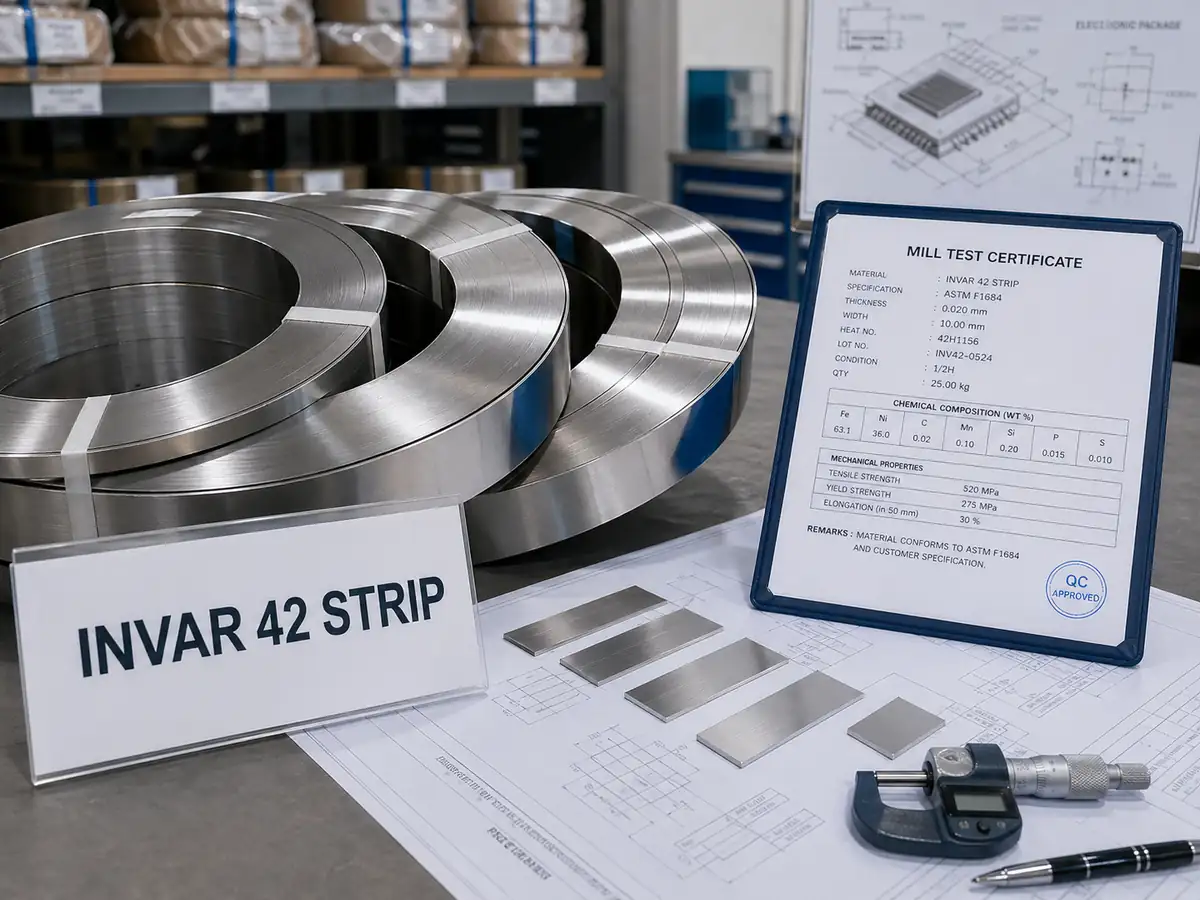
Why Controlled-Expansion Strip Needs Tight Supply Discipline
The first reason is application sensitivity. Invar 42 strip for electronics packaging is used where controlled expansion is not just beneficial but structurally important to the package concept. If the strip route is vague, poorly documented, or mixed casually with nearby stock, the buyer may not discover the weakness until stamping, assembly, or thermal-fit questions arise downstream. In electronics-related manufacturing, that is usually too late.
The second reason is coil complexity. Strip is often slit, recoiled, repacked, and allocated in smaller lots than plate or bar. That means an invar 42 strip for electronics packaging order needs strong lot discipline, document linkage, and width-by-width clarity from the beginning. Buyers should ask not just what the strip is, but how it will remain identifiable as it moves from incoming stock into narrower production lots. In precision packaging work, control of the path is part of control of the product.
| Strip concern | Why it matters | What buyers should verify |
| Coil and lot identity | Slitting and repacking can break traceability | Lot linkage, coil labels, and document continuity |
| Width and gauge control | Packaging components depend on dimensional consistency | Stock details tied to each slit or coil |
| Application fit | Controlled expansion is part of the component function | Real packaging use case and thermal expectations |
| Pre-production clarity | Late uncertainty disrupts precision manufacturing | Early review of documents and route details |
How to Buy Invar 42 Strip More Safely
The safest way to buy invar 42 strip for electronics packaging is to explain the packaging role before finalizing the order. Buyers should tell the supplier whether the strip will become frames, carriers, controlled-expansion parts, stamped components, or other packaging-related items. Those details help determine whether invar 42 strip for electronics packaging is the correct route and whether additional attention to slit-lot traceability or documentation should be built into the supply plan.
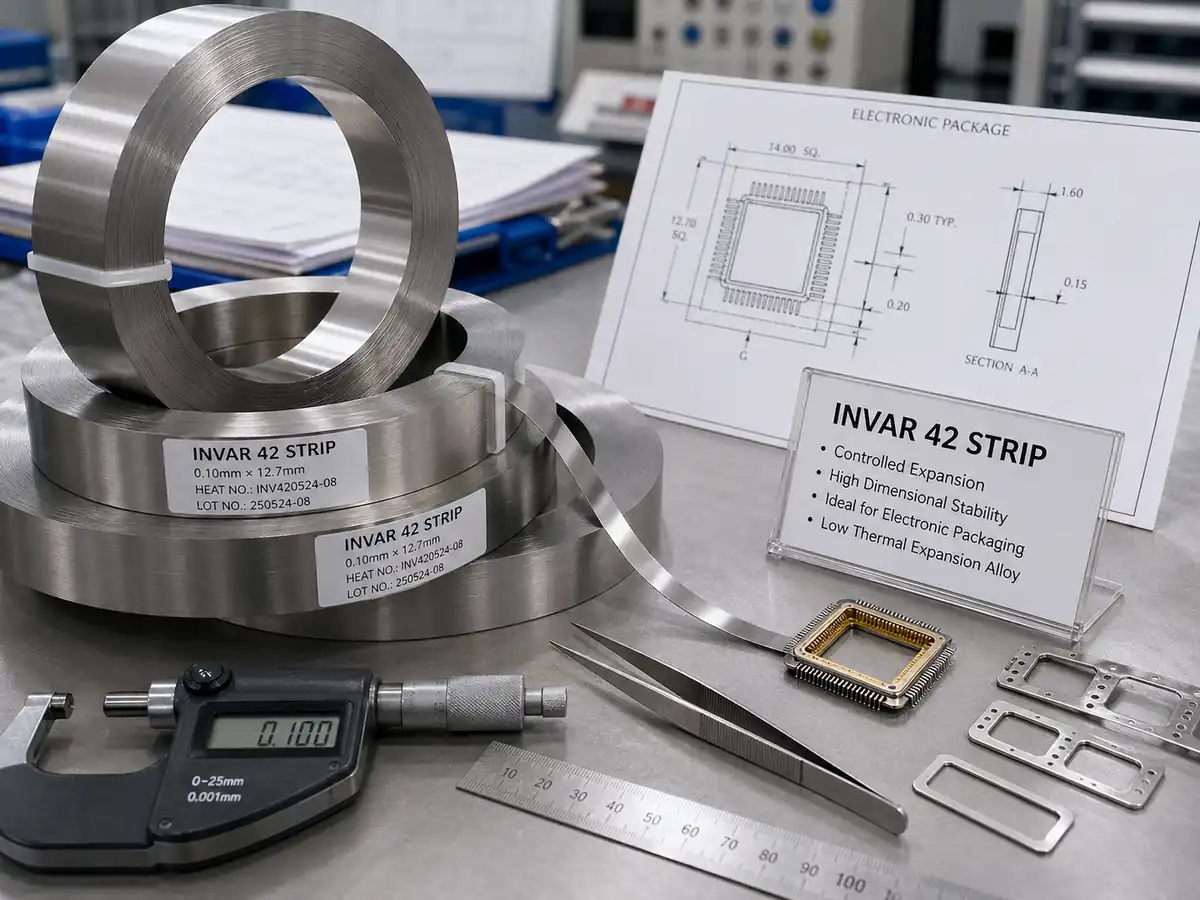
At 28Nickel, we usually encourage customers to evaluate suppliers by how well they preserve identity through coil handling. Ask whether the strip will be shipped as full coil, slit coil, or cut lengths; how each lot will be labeled; and whether the supplier has supported electronics-related controlled-expansion work before. The better these answers, the less likely invar 42 strip for electronics packaging will create doubt after the material is already inside a precision production flow.
A further benefit of early route clarity is that it helps align supplier logic with downstream stamping or packaging yield expectations. If one coil is going to feed multiple production lots or widths, that should be visible in the paperwork before the strip reaches the production floor. Invar 42 strip for electronics packaging performs best when material identity stays simple enough that production teams do not need to stop and reinterpret what the incoming lot really is.
Conclusion
Controlled-expansion strip only helps electronics packaging when the supply route stays as disciplined as the application. Good coil control usually prevents far more confusion than it costs. If you need help reviewing coil identity, slit-lot traceability, or route clarity for a strip order, 28Nickel can help confirm whether the proposed invar 42 strip for electronics packaging package is strong enough before release.
Related Q&A
Q: Why should buyers explain the exact packaging role of the strip?
Because invar 42 strip for electronics packaging is selected for its behavior in a specific package function, not just as a named strip alloy.
Q: Why is slit-lot traceability important?
Because strip is frequently divided into smaller coils or widths, and identity can become blurred quickly if labels and documents are weak.
Q: What should buyers ask besides nominal size?
They should ask about coil handling, lot labeling, document continuity, and whether the supplier has supported similar controlled-expansion packaging work.