









엔지니어가 다음과 같은 질문을 할 때 니켈 200 황산에 대한 내식성, the real question is rarely academic. It usually comes from a plant problem: premature wall loss in acid handling lines, contamination risk in chemical service, or uncertainty during material selection for a retrofit. In those situations, broad statements like “commercially pure nickel has good corrosion resistance” are not enough. Sulfuric acid is too condition-sensitive for that kind of shortcut.
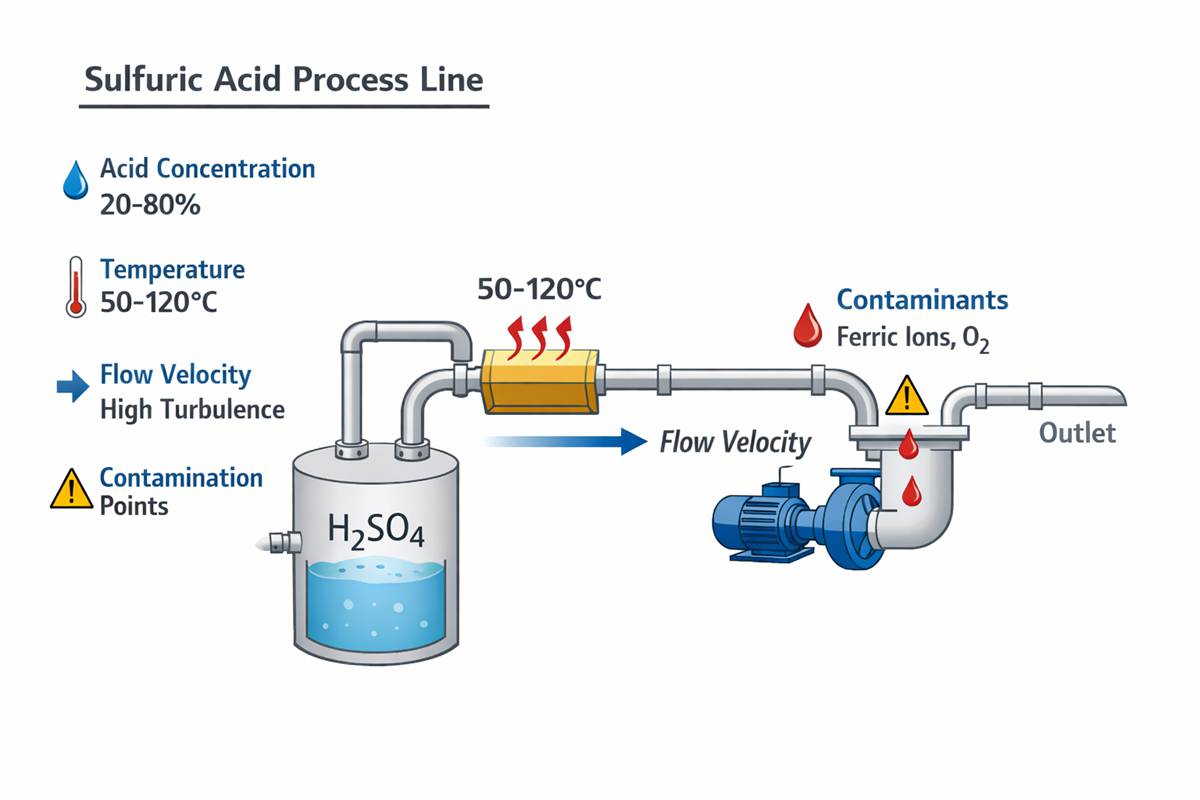
Nickel 200 is a wrought 상업적으로 순수한 니켈 grade with very low alloy content, high nickel content, good thermal conductivity, and excellent resistance in a range of reducing media. It is often considered where caustic service, food processing, and certain chloride-free chemical environments are involved. But Nickel 200 corrosion resistance in sulfuric acid depends strongly on acid concentration, temperature, aeration, fluid velocity, and the presence of oxidizing contaminants such as ferric ions or dissolved oxygen. In practice, that means the alloy can perform satisfactorily in some sulfuric acid services and fail rather quickly in others.
From a materials engineering standpoint, Nickel 200 should never be selected for sulfuric acid service based on one-variable thinking. The corrosion mechanism is not governed by acid concentration alone. Process impurities, intermittent heating, stagnant zones, and off-design upset conditions often control actual corrosion behavior more than the nominal design chemistry.

How Nickel 200 Behaves in Sulfuric Acid Service
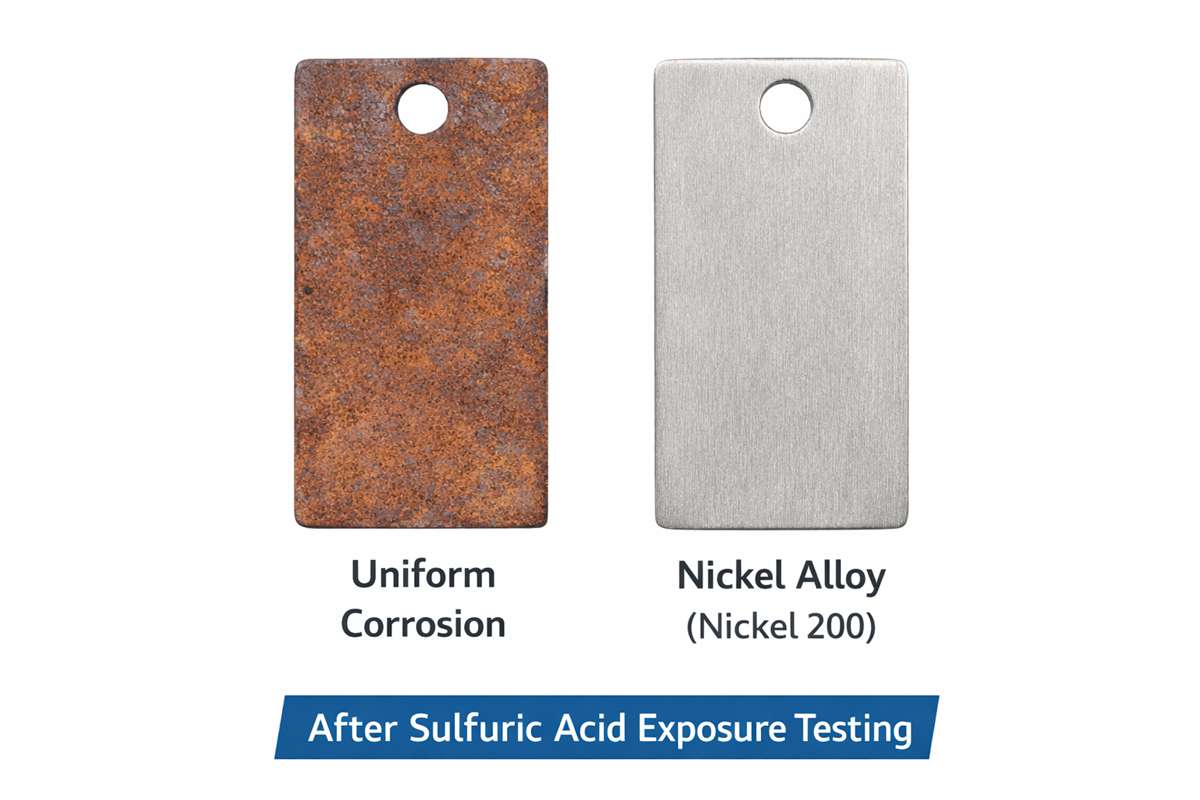
To understand Nickel 200 corrosion resistance in sulfuric acid, it helps to start with the nature of the alloy itself. Nickel 200 relies on the inherent stability of nickel in certain reducing environments. In clean, non-oxidizing conditions and at controlled temperatures, it may show useful resistance in selected sulfuric acid ranges. However, sulfuric acid is not uniformly reducing across all service conditions. As concentration and temperature rise, or when oxidizing species are present, the corrosion rate can increase sharply.
This is why engineers sometimes see conflicting field reports. One plant reports acceptable life in dilute acid at modest temperature, while another reports aggressive metal loss in apparently similar service. The difference often comes down to secondary factors:
1. Acid Concentration Range
Very dilute sulfuric acid can sometimes be less aggressive than intermediate concentrations, depending on operating temperature and contamination. Intermediate acid concentrations are often the most problematic for commercially pure nickel.
2. Temperature Sensitivity
Temperature is one of the most severe accelerators. A system that looks acceptable at ambient conditions may become marginal or unacceptable once the process crosses into elevated temperature operation. When evaluating Nickel 200 corrosion resistance in sulfuric acid, temperature excursions during start-up and cleaning cycles must be included.
3. Oxidizing Contaminants
Even small amounts of ferric sulfate, cupric ions, dissolved oxygen, or entrained oxidizing species can materially change corrosion behavior. This is where laboratory data and actual plant service often diverge.
4. Velocity and Localized Turbulence
Pure corrosion is not the only concern. High velocity, flashing, entrained solids, or impingement at elbows and nozzles can remove any weakly protective surface condition and accelerate attack.
In other words, Nickel 200 corrosion resistance in sulfuric acid is not “good” or “poor” in a universal sense. It is conditional, and the allowable window can be narrower than many buyers expect.
Practical Selection Guidance for Engineers and Buyers
For procurement teams, the biggest risk is assuming Nickel 200 behaves like a broadly acid-resistant nickel alloy. It does not. Commercially pure nickel has strengths, but general sulfuric acid service is not automatically one of them. In many mixed or heated acid systems, engineers end up moving toward higher-alloy nickel-based materials, depending on corrosion allowance, purity requirements, and lifecycle cost targets.
The table below summarizes a practical engineering view.
| Service Condition | Expected Nickel 200 Performance | 엔지니어링 코멘트 |
|---|---|---|
| Dilute sulfuric acid, low temperature, clean non-oxidizing solution | Potentially acceptable in selected cases | Requires confirmation by corrosion data and actual process chemistry review |
| Moderate concentration sulfuric acid at ambient temperature | Often uncertain to poor | One of the most dangerous assumption zones for material selection |
| Elevated temperature sulfuric acid | Generally unfavorable | Corrosion rate can rise quickly with temperature |
| Sulfuric acid with oxidizing contaminants | Often poor | Ferric ions or dissolved oxygen can significantly worsen attack |
| Intermittent service with start-up/shutdown cycling | Risky without detailed review | Upset conditions may dominate real corrosion damage |
| High-purity process requiring low metallic contamination | Situational | Nickel purity may help, but corrosion risk must still be qualified |
A disciplined selection process should include the following:
- Define minimum, normal, and upset acid concentration.
- Confirm operating and excursion temperatures.
- Identify trace contaminants, especially oxidizing species.
- Check whether the system is stagnant, recirculating, or erosive.
- Review whether weld zones will see different chemistry or heat tint exposure.
- Compare expected corrosion allowance against required service life.
This is where experienced technical support matters. A supplier who only offers a datasheet is not really helping. For sulfuric acid duty, engineers need a materials discussion grounded in corrosion mechanism, fabrication route, and actual service envelope.
Where Nickel 200 Can Still Be Worth Considering
Despite the cautions, Nickel 200 corrosion resistance in sulfuric acid should not be dismissed outright. There are niche cases where it remains technically reasonable, especially when the environment is tightly controlled, temperatures are low, and oxidizing contamination is absent. It may also be evaluated for ancillary components rather than the most severe wetted sections of the process.
In fabrication terms, Nickel 200 offers good workability and weldability, which can be an advantage for custom vessels, transfer lines, nozzles, and heat-transfer components. It also performs well in many alkaline environments, so some plants already standardized on pure nickel may explore it for limited sulfuric acid exposure. The key is discipline. Materials selection should be based on verified corrosion data, not on family resemblance to other 니켈 합금.
A veteran corrosion engineer will usually ask one more question: what is the consequence of being wrong? If the answer involves acid leakage, contamination of product, or unplanned shutdown, then a conservative alloy review is warranted. That is precisely why Nickel 200 corrosion resistance in sulfuric acid should be treated as a technical evaluation topic, not a catalog keyword.

결론
The most accurate answer to the question of Nickel 200 corrosion resistance in sulfuric acid is this: it is highly dependent on service conditions, and it should never be generalized without concentration-temperature-contamination review. In controlled low-temperature, non-oxidizing environments, Nickel 200 may be viable. In hotter, more concentrated, or oxidizing sulfuric acid service, the alloy often becomes a risky choice.
For engineers and buyers, the practical lesson is simple. Do not purchase Nickel 200 for sulfuric acid duty based on a generic corrosion statement. Evaluate the full process envelope, including upset conditions, impurities, flow pattern, and required service life. If you are reviewing a sulfuric acid application and need alloy selection support, a technical discussion based on process details will save far more cost than replacing the wrong material later.
관련 Q&A
1. Is Nickel 200 suitable for hot sulfuric acid?
Usually not as a default choice. As temperature increases, sulfuric acid becomes much more aggressive to commercially pure nickel, and corrosion rates can rise beyond acceptable design limits.
2. What factors most affect Nickel 200 corrosion resistance in sulfuric acid?
The most important variables are acid concentration, operating temperature, oxidizing contaminants, flow condition, and whether the system experiences start-up or cleaning upsets.
3. Should Nickel 200 be selected from datasheet corrosion claims alone?
No. Sulfuric acid service requires condition-specific evaluation. Datasheet-level statements are too broad for safe engineering selection in real plant environments.