










Handling Liquefied Natural Gas (LNG) at a punishing -162°C (-260°F) demands extreme metallurgical rigor from every piping component. At these severe cryogenic temperatures, standard carbon steels undergo a fatal ductile-to-brittle transition, effectively shattering like glass under operational pressure. This is precisely why specifying a seamless nickel alloy pipe for LNG applications isn’t just an engineering option; it is an absolute structural necessity for offshore platforms, coastal liquefaction trains, and transfer terminals. As materials engineers, we must address massive thermal contraction and intense pressure cycling simultaneously. When you engineer a pipeline without weld seams, you inherently eliminate the primary nucleation sites for stress corrosion cracking and localized fatigue failure in cryogenic environments. Let us break down the underlying metallurgical mechanics behind this critical material selection.
The Superiority of Face-Centered Cubic (FCC) Structures
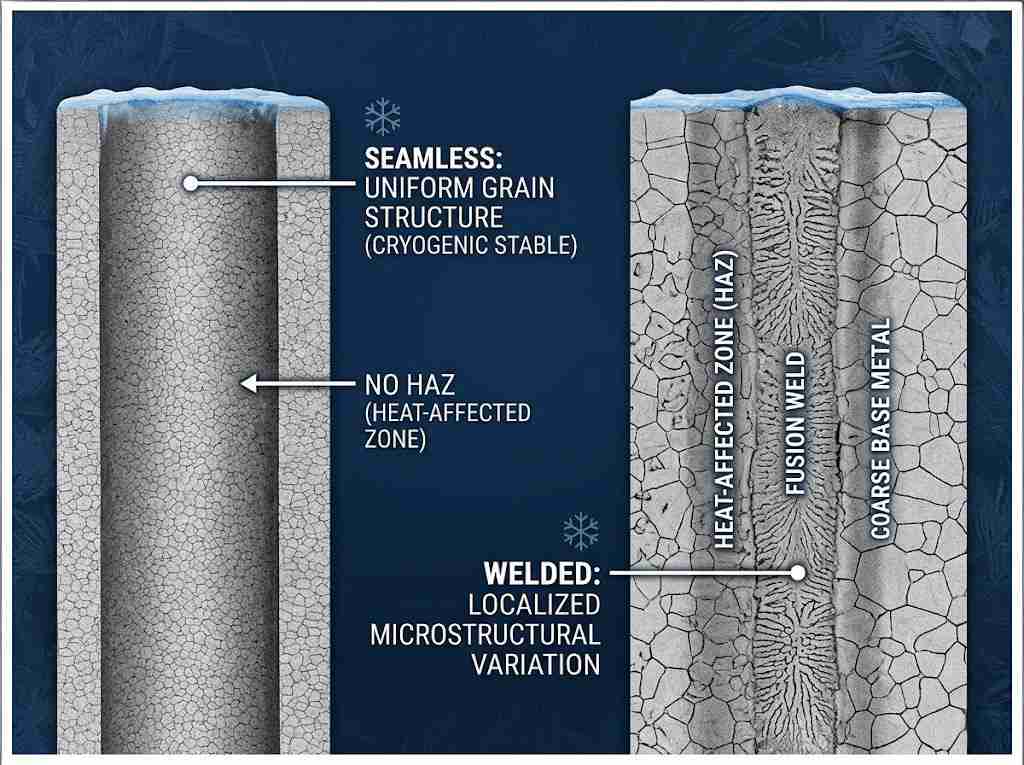
The superiority of seamless nickel-based alloys in demanding cryogenic service stems primarily from their face-centered cubic (FCC) crystal structure. Unlike body-centered cubic (BCC) metals, FCC alloys maintain their ductility, toughness, and impact resistance even as temperatures approach absolute zero. When we deploy a seamless nickel alloy pipe for LNG applications, we are fundamentally relying on this inherent austenite stability. The complete absence of a longitudinal weld seam removes the heat-affected zone (HAZ) from the pipeline’s cross-section. The HAZ typically exhibits erratic grain growth and localized precipitation of brittle intermetallic phases, which act as critical failure points under cryogenic thermal shock.
Furthermore, the immense pressure ratings required for deep-water LNG transfer lines necessitate perfectly uniform wall thickness and completely isotropic mechanical properties. High-nickel metallurgical grades provide an extraordinary combination of high ultimate tensile strength and a remarkably low coefficient of thermal expansion (CTE). This specifically reduces the dangerous thermal stresses generated during the rapid cool-down and warm-up phases of LNG loading and offloading operations.
| Material Grade | Yield Strength (MPa) | Tensile Strength (MPa) | Elongation (%) | Charpy V-Notch Impact at -196°C (J) |
| 316L Stainless Steel | 290 | 580 | 45 | 110 |
| 9% Nickel Steel | 585 | 690 | 20 | 95 |
| Alloy 625 (Seamless) | 517 | 930 | 42 | 135 |
| Invar 36 (36% Ni) | 240 | 490 | 40 | 120 |
Processing and Field Installation Advantages
Creating a true seamless nickel alloy pipe for LNG applications requires precision hot extrusion followed by rigorous cold pilgering processes. This advanced thermomechanical processing refines the microstructural grain size, vastly enhancing the pipe’s resistance to hydrogen embrittlement and dynamic shock loads. These shock loads are common occurrences during liquid hammer events when cryogenic fluid transfer valves are rapidly actuated.
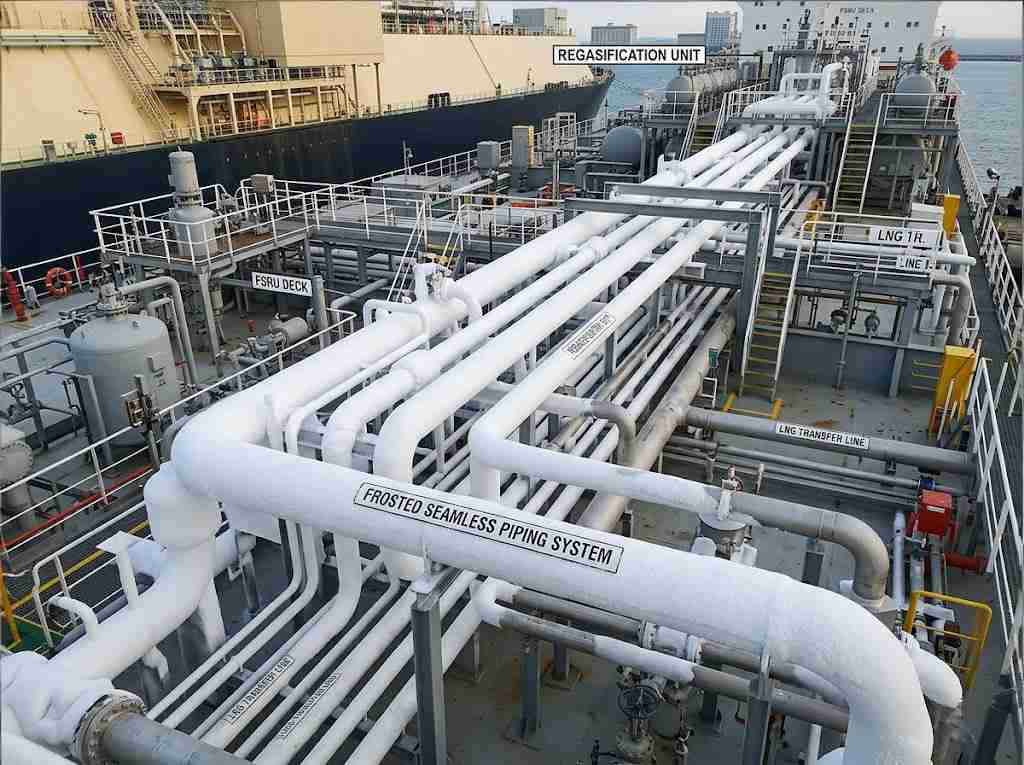
At 28Nickel, our engineering team frequently consults on complex terminal designs where EPC contractors struggle with pipe routing due to extreme thermal bowing. By selecting the optimal nickel alloy with a calculated, predictable CTE, expansion loops can be significantly minimized. This critical space-saving measure reduces the spatial footprint on highly crowded floating storage and regasification units (FSRUs). Ultimately, the microstructural integrity of a seamless nickel alloy pipe for LNG applications directly correlates to the long-term operational uptime and safety rating of the entire gas facility.
Weldability of the pipe ends during field installation is another major factor. Seamless construction means field engineers only need to manage and rigorously inspect circumferential butt welds, rather than constantly worrying about the structural integrity of miles of longitudinal factory seams. For project procurement teams, this translates directly to drastically reduced non-destructive testing (NDT) costs and much faster project commissioning schedules. We have seen firsthand how rigorous, upfront material selection directly mitigates catastrophic downstream equipment failures.
Secure Your LNG Infrastructure with 28Nickel
Navigating the strict regulatory specifications of API 5LC and ASME B31.3 for severe cryogenic service requires far more than just skimming a material datasheet. The distinct microstructural advantages of a seamless nickel alloy pipe for LNG applications provide the ultimate safety factor against catastrophic brittle fracture and thermal fatigue. However, matching the exact alloy grade—whether it happens to be a 9% nickel steel variant, a controlled-expansion Invar alloy, or a high-performance Inconel grade—to your specific thermal gradients and pressure cycling parameters is a highly complex metallurgical puzzle. Do not leave your multimillion-dollar facility’s structural integrity to chance or guesswork. Contact the specialized metallurgical engineering team at 28Nickel today with your project schematics and operational parameters. Let our experts provide precise, data-backed material recommendations and tailored supply solutions for your next major LNG terminal project.
Related Q&A
Q1: What is the main metallurgical advantage of a seamless nickel alloy pipe for LNG applications over welded alternatives?
A1: The primary advantage is the total elimination of the longitudinal Heat-Affected Zone (HAZ). In cryogenic conditions, weld seams and their associated HAZ can become nucleation sites for brittle fractures due to altered grain structures. Seamless construction provides isotropic strength and uniform ductility across the entire pipe circumference at -162°C.
Q2: How does the nickel content affect the Ductile-to-Brittle Transition Temperature (DBTT)?
A2: Nickel acts as a powerful austenite stabilizer. As the nickel content increases, the material’s crystal lattice firmly retains its Face-Centered Cubic (FCC) structure, which inherently lacks a DBTT. This ensures the pipe remains highly ductile and absorbs impact energy rather than shattering when exposed to extreme LNG temperatures.
Q3: Which international specifications govern a seamless nickel alloy pipe for LNG applications?
A3: Key governing standards include ASME B31.3 (Process Piping) for overall design and fabrication, alongside API 5LC (CRA Line Pipe) and ASTM specifications like B444 or B423, depending on the exact nickel alloy grade selected. Full compliance ensures proper chemical composition limits and mandates rigorous cryogenic mechanical testing.